What Are Derivatives? The $846 Trillion Illusion
Eight times the world economy, they say. The actual market value is about $22 trillion — and after netting, far less. Here is what derivatives really are.
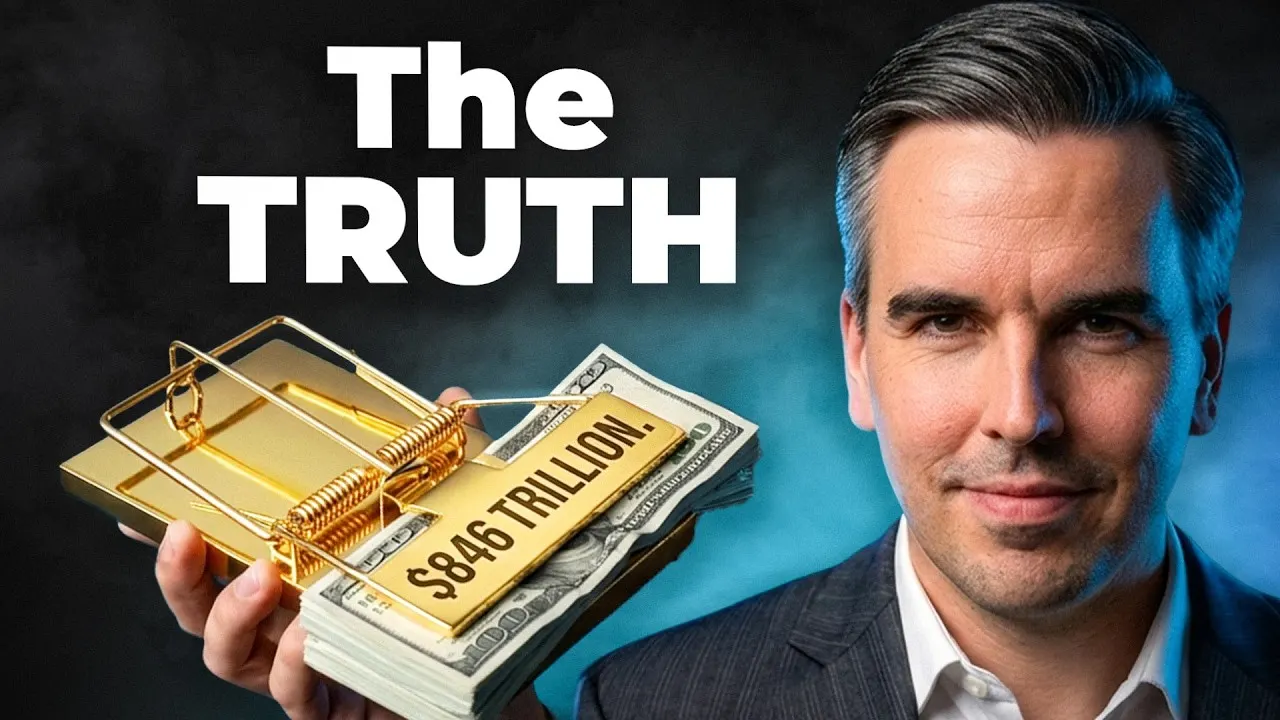
Why a $846 Trillion Market Isn't the Trap Everyone Thinks It Is
Prefer to watch? This article is the written companion to the video above.
Eight hundred and forty-six trillion dollars.
That is the size of the global derivatives market, eight times the entire world economy. Every crisis documentary, every Reddit thread, every headline says the same thing: derivatives are a ticking time bomb.
That number is an optical illusion.
The actual market value of all those contracts is about $21.8 trillion — roughly 2.6% of the headline figure. And after netting, the real exposure is smaller still. The gap between the terrifying number and the actual risk is a factor of forty. Understanding why is the difference between fearing derivatives and understanding them, and you rely on them every single day, whether you trade one or not.
The optical illusion
The face value of the contracts — the size of the thing they are written about.
What the contracts are actually worth. The green slice is drawn to scale — 2.6%.
The headline and the real number differ by a factor of ~40. And that is before netting — once offsetting positions cancel out, the exposure actually at stake is smaller again.
What the big number actually measures
The $846 trillion is the notional amount, the face value of the contracts. It is not money at risk. It is the size of the thing the contract is written about.
The gross market value, what the contracts are actually worth, was about $21.8 trillion at mid-2025, according to the Bank for International Settlements. And then there’s netting, which shrinks it further.
Bank A owes Bank B $100 million. Bank B owes Bank A $90 million.
The scary headline: $190 million at risk. The reality: $10 million. The net.
Across the whole market, vast gross positions collapse into much smaller net exposures, because most participants hold offsetting contracts on both sides. Notional is the headline. Exposure is the reality, and that single distinction dissolves most of the fear.
The illusion is real. The trend underneath it is not an illusion.
Having spent four paragraphs telling you not to be frightened by the big number, I should tell you what the same BIS release says about how it got there, because it is the part nobody quotes.
That $846 trillion was up 16% in a single year. The BIS notes, in its own flat prose, that this is the largest year-on-year increase observed since 2008, and that it comes against a moderate 5% annual trend that had held since 2016. Gross market value rose 29% over the same year, the biggest jump since 2022.
So the correct reading is not “the number is meaningless”. It is that the number measures the wrong thing and the wrong thing is growing at a rate last seen in the year before the financial crisis. The BIS attributes it to trade uncertainty, monetary policy and geopolitics, which is a polite way of saying the world got harder to predict — and everybody went out and bought protection at once.
One figure inside that deserves a moment. Foreign exchange derivatives alone are $155 trillion, and $100 trillion of those are forwards and swaps maturing within a year. That is a hundred trillion dollars of obligations that have to be rolled over, continuously, by institutions who assume the market will be open and willing when they need it. It works, almost always. It is also the single largest thing in global finance that depends on a market being open on a specific Tuesday — and nobody has a plan for the morning it is not.
What a derivative actually is
Forget the textbook. Here is the whole idea in one story.
You are a wheat farmer. It is March; your harvest comes in September. Wheat sells for $200 a tonne, a good price. But September is six months away, and you fear a crash.
So you find a bread factory and shake hands: in September you deliver wheat, they pay $200 a tonne, no matter what the market does in between. That contract is a derivative.
It is the oldest financial instrument there is. Four thousand years ago, Mesopotamian merchants wrote deals exactly like this on clay tablets.
Notice what happened: the farmer removed risk, the factory removed risk, and nobody gambled. Both sides sleep better.
Now scale it up, because you are already surrounded by these:
You already rely on them — today
Your fixed-rate mortgage
runs on a Interest rate swap
Your bank borrows at rates that move daily, and hands you a rate locked for decades.
Your pension
runs on a Put options
Insurance on its stock portfolio, so a crash near your retirement does less damage.
Your airline ticket
runs on a Futures
The airline locks in fuel prices in advance, so the fare does not swing with oil.
A currency-hedged ETF
runs on a FX forwards
The exchange-rate risk is stripped out inside the fund, before it reaches you.
Not casino chips. Market infrastructure — moving risk from someone who cannot carry it to someone who will.
Swaps, forwards, futures, options: many names, one logic, which is to transfer risk from someone who cannot carry it to someone willing to. Without them, every bank, airline and pension fund would be flying blind. They are not casino chips. They are market infrastructure.
But the same tool that protects the farmer can blow up a system, with the wrong incentives and zero collateral discipline. Which brings us to the company at the centre of 2008.
The $182 billion disaster
September 2008. Banks collapsing, Lehman gone. And at the centre of it, a company almost nobody had heard of: AIG. An insurer. Trillion-dollar balance sheet, AAA-rated, the most trusted name in the room.
AIG had a small division, about 400 people, writing credit default swaps: insurance on debt. If a company or mortgage pool defaulted, AIG promised to pay. Banks loved it, because buying protection from AIG let them tell regulators their risky mortgage holdings were covered. AIG collected premiums. For years.
The problem: it wrote over $500 billion of these contracts and set aside essentially nothing to cover claims. It assumed mortgages would never default at scale — and that its AAA rating meant nobody would ever demand cash upfront. Wrong on both counts.
When housing cracked, AIG was downgraded, and the moment that happened, every counterparty demanded collateral. Cash. Now. About $32 billion in collateral calls within weeks, and AIG did not have it. If AIG collapsed, every bank relying on its protection would suddenly be unprotected, cascading through the entire system. The US government stepped in with $182 billion, the largest bailout in history.
Here is what almost everyone gets wrong
The derivative did not fail. The governance did. AIG used an insurance tool and forgot to reserve for claims. It sold protection without being able to protect.
And the proof is in the same crisis: the exchange-traded derivatives market worked. Every futures contract settled. Every margin call was met. The system with rules, transparency and daily collateral held. The opaque, over-the-counter world where AIG operated, without any of that, broke.
Same instruments. Opposite outcomes. The difference was entirely the discipline around them.
Which is worth defining, since everything above turns on it
“Collateral discipline” gets used as though everyone knows what it means mechanically. Most people do not, and it is not complicated.
What "collateral discipline" actually means
Two kinds of margin, doing two different jobs
Initial margin
Posted before anything happens
A deposit sized to cover a plausible worst-case move over the days it would take to close your position out.
Answers: if this counterparty vanishes tomorrow, is there enough on the table to unwind them without anyone else getting hurt?
Variation margin
Settled every single day
Yesterday’s gain or loss, moved in cash from the losing side to the winning side, before the next day starts.
Answers: has anyone quietly accumulated a loss they cannot pay? The answer is checked daily, so it can never be a surprise.
And the same mechanism, from the other side
Variation margin is why losses cannot hide. It is also why a bad week becomes a forced sale: the cash is due tomorrow whatever else you had planned, and if you do not have it, you sell something to get it. In a falling market everyone sells the same things on the same morning.
AIG had written protection with almost no margin against it, so the loss stayed invisible until the downgrade made it all payable at once. The UK pension funds had margin working exactly as designed, and it was the margin calls themselves that forced the selling. Neither failure was in the contract. Both were in how much had been borrowed behind it.
Both mechanisms sound protective, and both are. But notice that variation margin has a second face. It is what makes losses impossible to hide, and it is also what converts a falling market into forced selling, because the cash is due tomorrow regardless of what you think the position is worth.
That is the thread running through every derivatives disaster of the last twenty years. AIG had written enormous protection with almost no margin behind it, so the loss stayed invisible until a credit downgrade made it all payable at once. The UK pension funds in 2022 had margin working exactly as designed, and it was the calls themselves that forced them to sell. Archegos had margin, spread thinly across prime brokers who could not see each other’s exposure. Different failures, one shape — the contract behaved correctly and the leverage behind it did not.
The Buffett paradox
In his 2002 letter, Warren Buffett called derivatives “financial weapons of mass destruction”: hidden leverage, opaque contracts, unmeasurable risk. Six years later, AIG proved him right.
And yet, between 2004 and 2008, Buffett himself sold put options on major stock indices with a notional around $37 billion, plus credit default swaps, collecting billions in premiums.
Hypocrite? Look closer. He followed three rules AIG broke:
Same instrument. Opposite discipline.
AIG
AAA insurer · 2008
- The instrument
- Credit default swaps — insurance on debt.
- The cash behind it
- Wrote ~$500bn. Reserved essentially nothing.
- Margin calls
- ~$32bn demanded within weeks. Could not pay.
- Time horizon
- Protection due the instant its rating fell.
- The outcome
- $182bn bailout — the largest in history.
Buffett / Berkshire
Same tool · 2004–08
- The instrument
- Put options on stock indices (~$37bn notional).
- The cash behind it
- Tens of billions in reserves — every contract covered.
- Margin calls
- Structured so no one could demand cash overnight.
- Time horizon
- Options expiring 15–20 years out.
- The outcome
- Collected billions in premiums.
The instrument was identical. The discipline decided everything.
He even used a simple derivative to enter Coca-Cola: he sold a put at $35, collected $7.5 million in premium, and either bought the stock at a discount or kept the cash. Value investing, using a derivative.
The scalpel principle. In a surgeon’s hands it saves lives; in reckless hands it does damage. The instrument is not the problem. The user is.
What changed after 2008, and what didn’t
Regulators rebuilt the plumbing:
- Central clearing. A clearinghouse now sits between buyer and seller for standardised contracts, absorbing the shock if one side defaults.
- Mandatory margins. Daily cash settlement, so exposure cannot silently accumulate. Roughly three quarters of interest rate derivatives are now centrally cleared, up from under a quarter before 2008.
- Transparency. Regulators can now see who holds what.
In Europe, EMIR, MiFID and MiCA built some of the strictest frameworks anywhere. That is not a shackle. Handled well, it is an edge.
But the system is not bulletproof, and when it fails now, the failure has moved from the tool to the leverage behind it.
September 2022. UK pension funds used interest rate swaps to manage long-term liabilities, which is sensible, until a mini-budget triggered the fastest gilt sell-off in decades. Thirty-year yields spiked around 140 basis points in three days. Margin calls exploded. Funds were forced to sell bonds into a falling market, pushing prices down further, triggering more margin calls. A death spiral, until the Bank of England intervened.
The derivatives worked exactly as designed. The leverage behind them did not. (The full anatomy of that near-collapse is worth reading on its own.)
Risk does not vanish. It shifts.
What this means for you
Should you trade derivatives? For most people, honestly, no. Not directly.
Between 74% and 89% of retail accounts trading CFDs lose money. That is not opinion; it is the mandatory disclosure every European broker must show you.
The biggest myth is that derivatives are only for gamblers. In reality, over 60% of companies use them for hedging, meaning risk reduction rather than speculation.
But here is what matters: you already benefit from them every day. Your mortgage rate, your currency-hedged ETF, your pension, all rest on derivatives running quietly in the background. Understanding how these tools work makes you a better investor even if you never trade one.
For advanced investors, legitimate strategies exist: a protective put to insure a position through a risky event, a covered-call ETF for income, knowing it caps your upside. But the honest answer is that derivatives are power tools. Professionals use them daily, and for most individuals, understanding the mechanics beats trading them.
The verdict
Derivatives are not a separate asset class, and not an investment. They are the operating system running behind every portfolio on the planet.
$846 trillion sounds terrifying. Behind it: banks managing interest-rate risk, airlines locking in fuel, pension funds protecting retirements, farmers securing harvests.
And the disasters, AIG and the UK pension crisis and Archegos, were not caused by the tool. They were caused by leverage without limits and governance without discipline.
Three things to remember:
- Notional is the headline. Exposure is the reality.
- Governance beats the gadget. Every time.
- Regulation, done right, is not a shackle. It is an edge.
The tool is not the risk. The terms are. The collateral is. The discipline is.
Educational content only — not investment advice, and not a personal recommendation. CFDs and other leveraged derivatives carry a high risk of rapid loss. Speak to a qualified, licensed professional before acting.
Keep going
Finished reading? Three places to go next
- Next in Which Asset Class Is For You? · episode 9Rules Over Access: What the World's Biggest Fund Does Differently Norway's fund holds no hedge funds and no private equity, costs 0.04%, and returned 15.1% in 2025. Yale returned 11.1%. The difference is governance, not access.
- Read nextWhy Are Interest Rates So High in 2026? What It Means for You The 10-year Treasury hit its highest close since 2002 in October 2026. What's behind it, and what it means for your mortgage, savings and bonds.
- On YouTubeSubscribe on YouTube (opens YouTube in a new tab)New videos every Tuesday: one money question per episode, checked against the data.
Primary sources (4)
- 01OTC derivatives statistics at end-June 2025 — notional $846tn, gross market value $21.8tn — Bank for International Settlements (BIS)
- 02Congressional Oversight Panel / GAO — the $182bn federal support for AIG — U.S. Government Accountability Office
- 03Berkshire Hathaway Shareholder Letter 2002 — 'financial weapons of mass destruction' — Warren Buffett / Berkshire Hathaway
- 04OTC derivatives statistics at end-June 2025 (published 8 December 2025): notional $846tn, up 16% year-on-year — "the largest year-on-year increase observed since 2008" against a 5% trend since end-2016; gross market value $21.8tn, up 29%; FX derivatives $155tn, of which $100tn mature within a year — Bank for International Settlements
Questions people actually ask
Is the derivatives market really $846 trillion?
That number is real but badly misunderstood — it is the notional amount, the face value of the contracts, not the money at risk. According to the Bank for International Settlements, OTC derivatives notional reached $846 trillion at mid-2025. But the gross market value — what the contracts are actually worth — was about $21.8 trillion, roughly 2.6% of the headline. And after netting, where offsetting positions cancel out, the real exposure is smaller again. The scary figure and the actual risk differ by a factor of forty.
What is netting, and why does it shrink the number so much?
Netting cancels offsetting obligations between two parties. Suppose Bank A owes Bank B $100 million and Bank B owes Bank A $90 million. The frightening headline says $190 million is at risk. The reality is $10 million — the net. Across the whole market, enormous gross positions collapse into much smaller net exposures once you account for the fact that most participants hold offsetting contracts. The notional is the sum of the gross promises; the exposure is what is left after they cancel.
What actually is a derivative?
A contract about a future price — the oldest financial instrument there is; Mesopotamian merchants wrote them on clay tablets 4,000 years ago. Picture a wheat farmer in March whose harvest comes in September. Wheat is $200 a tonne now, but he fears a crash. So he agrees today with a bread factory: in September he delivers wheat, they pay $200 a tonne, whatever the market does. The farmer removes risk, the factory removes risk, nobody gambles. That contract is a derivative.
Do I already use derivatives without knowing it?
Almost certainly. Your fixed-rate mortgage exists because your bank borrows at rates that change daily and uses an interest rate swap to offer you a locked rate. Your pension is very likely protected against crashes with put options. A currency-hedged ETF uses FX forwards internally. An airline uses futures to lock in fuel so your ticket price stays stable. Swaps, forwards, futures, options — many names, one logic: transfer risk from someone who cannot carry it to someone who will. They are market infrastructure, not casino chips.
What happened with AIG in 2008?
AIG — a trusted, AAA-rated insurer with a trillion dollars in assets — had a small division of about 400 people writing credit default swaps: insurance on debt. Banks bought this protection so they could tell regulators their risky mortgage holdings were covered. AIG collected premiums for years. The problem: it wrote over $500 billion of these contracts and set aside essentially nothing to pay claims, assuming mortgages would never default at scale. When housing cracked, AIG was downgraded, every counterparty demanded collateral at once — about $32 billion within weeks — and AIG did not have it. The government stepped in with $182 billion, the largest bailout in history.
So did the derivative cause the AIG disaster?
No — the governance did, and the distinction matters enormously. AIG used an insurance tool and forgot to reserve for claims; it sold protection without being able to protect. During the very same crisis, the exchange-traded derivatives market worked: every futures contract settled, every margin call was met. The system with rules, transparency and daily collateral held. The opaque, over-the-counter world where AIG operated, without any of that, broke. Same instruments, opposite outcomes — decided entirely by the discipline around them.
Why did Warren Buffett call derivatives 'weapons of mass destruction' and then use them?
In his 2002 letter he warned that derivatives carried hidden leverage, opaque terms and unmeasurable risk — and AIG proved him right six years later. Yet between 2004 and 2008 he sold put options on stock indices with a notional around $37 billion and sold credit default swaps, collecting billions in premiums. The apparent contradiction resolves into three rules AIG broke: he held the cash to cover every contract, he structured them so nobody could demand margin overnight, and his options expired 15–20 years out, a bet that markets would be higher in two decades. It is the scalpel principle: the instrument is not the problem, the user is.
What changed after 2008?
Regulators rebuilt the plumbing in three material ways. Central clearing: a clearinghouse now sits between buyer and seller for standardised contracts, absorbing the shock if one side defaults. Mandatory margins: daily cash settlement, so exposures cannot silently accumulate — roughly three quarters of interest rate derivatives are now centrally cleared, up from under a quarter before 2008. And transparency: regulators can see who holds what. In Europe, EMIR, MiFID and MiCA built some of the strictest frameworks anywhere. That is not a burden; handled well, it is an edge.
Is the system safe now?
Safer, but not bulletproof — and the way it fails has shifted from the tool to the leverage behind it. In September 2022, UK pension funds using interest rate swaps to manage long-term liabilities were hit when a mini-budget triggered the fastest gilt sell-off in decades. Margin calls exploded, funds were forced to sell bonds into a falling market, prices fell further, more margin calls followed, and the Bank of England had to intervene. The derivatives worked exactly as designed. The leverage behind them did not. Risk does not vanish; it shifts.
Should I trade derivatives?
For most people, honestly, no — not directly. Between 74% and 89% of retail accounts trading CFDs lose money, which is not opinion but the mandatory disclosure every European broker must show you. The bigger myth is that derivatives are only for gamblers: over 60% of companies use them to reduce risk, not to speculate. For most individuals, understanding the mechanics — so you know what is running behind your mortgage, ETF and pension — beats trading them. Legitimate strategies exist for advanced investors, such as a protective put to insure a position, but that is a different conversation. Nothing here is a personal recommendation.