Bitcoin Is Not Digital Gold: 2025 Gold +67%, BTC -6%
Same year, same fears: gold rose 67.4%, bitcoin fell 6.3%. It does not trade like a safe haven — it trades like a leveraged tech stock.
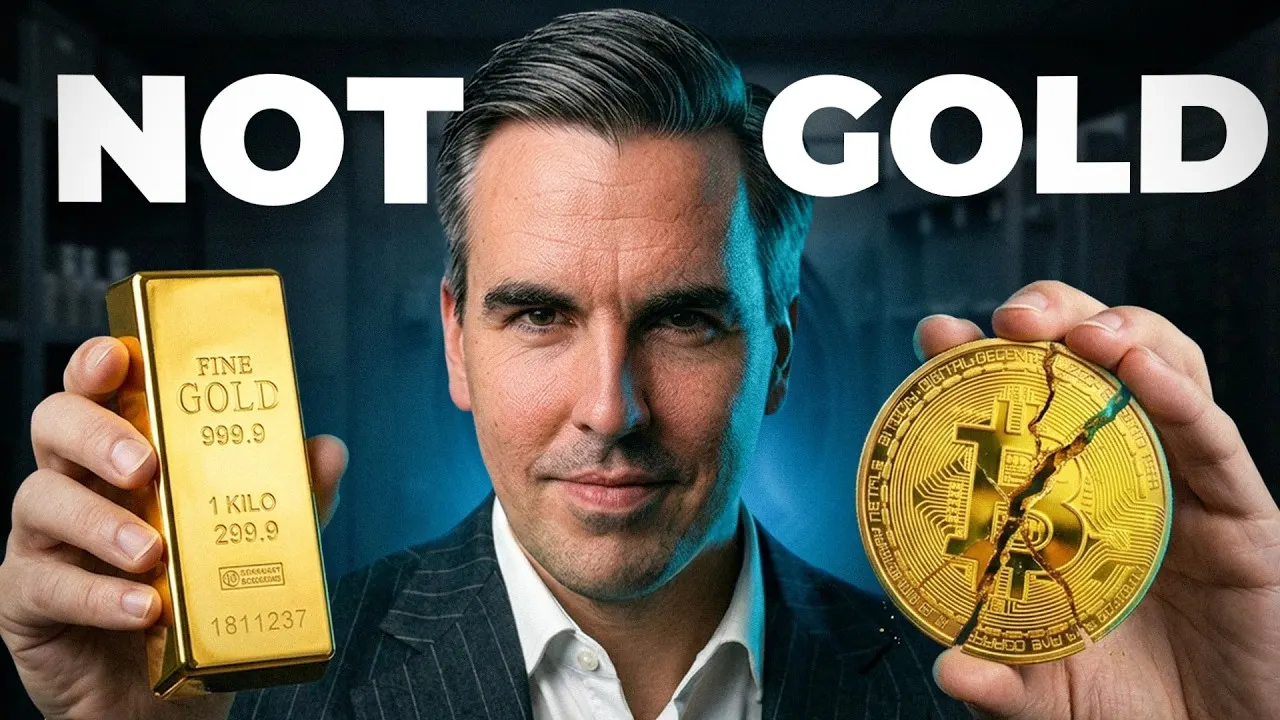
Bitcoin Is NOT Digital Gold (BlackRock's Institutional Proof)
Prefer to watch? This article is the written companion to the video above.
“Make banks irrelevant.”
That was the mission. In 2008, an anonymous author published nine pages describing a currency that needed no banks, no intermediaries, no central authority. A rebellion against the entire financial system.
Now look at where the rebellion ended up. The largest bitcoin fund in the world is run by BlackRock. Goldman Sachs reports substantial bitcoin ETF holdings. The instrument built to make banks obsolete is distributed, custodied and monetised by the banks.
The rebellion did not destroy the financial system — the financial system absorbed it. And that changes how you should think about the asset, starting with the claim that it is digital gold.
2025 ran the experiment for us
If bitcoin is digital gold, then in a year of macro anxiety and geopolitical stress it should behave like gold. 2025 was exactly that year. Same fears, same headlines, same worries about debt and currencies.
Calendar year 2025
The experiment nobody had to design
The year everyone worried about debt and currencies.
The same year. The same worries.
Two assets that are supposed to do the same job, tested at the same time, on the same fears, 73.7 percentage points apart.
One year proves nothing on its own, and I would not build an argument on a single calendar. What makes this one worth showing is that it was the exact scenario the "digital gold" case describes: sovereign debt in the headlines, currency anxiety, geopolitical stress. The thesis got the conditions it asked for.
Gold returned +67.4% over the calendar year. Bitcoin returned −6.3%.
Same crisis. Opposite reactions. Two assets that are supposed to do the same job, tested at the same time, moving in opposite directions. That is not a nuance. That is the argument, settled.
Why: bitcoin trades like a tech stock
Look at what it actually correlates with. Against the Nasdaq, persistently high. Against gold, around zero.
That is not the profile of a safe haven. It is the profile of a leveraged technology stock: it rallies when liquidity is abundant and risk appetite is high, and it is sold when liquidity tightens. Which is precisely what happened.
On 10 October 2025, crypto markets suffered the largest single-day liquidation event in their history, roughly $19 billion of positions forcibly unwound, days after bitcoin had touched an all-time high. (For the year as a whole, total crypto liquidations exceeded $150 billion.)
Sit with what that means. When the market turned, bitcoin was not the thing people ran to. It was the thing that got sold — because it is liquid, because it is leveraged, and because in a margin call you sell what you can, not what you want.
An asset that gets liquidated in a panic is not the asset that protects you from one.
No, BlackRock is not buying bitcoin
This deserves its own section, because it is the most expensive misunderstanding in crypto media.
BlackRock runs an ETF. The bitcoin inside that fund belongs to the people who bought the shares, not to BlackRock, which earns a management fee for operating the vehicle. BlackRock did not place a bet. It built a toll road and it is collecting the toll, which as a business is significantly better than the bet.
“BlackRock offers a bitcoin product” and “BlackRock believes in bitcoin” are different sentences. Only one of them is true, and it is not the one you have been reading. The same applies to most of the “institutions are buying” headlines: what is being reported is distribution, not conviction.
Who is actually buying, and who is refusing
Real money is going in. Strategy, formerly MicroStrategy, has bought aggressively with its own balance sheet, financed by equity issuance and convertible debt, and has carried multi-billion-dollar unrealised losses through corrections. That is genuine skin in the game and genuine risk. Some endowments and a handful of public pension funds have taken small positions, and a large share of ETF demand has come from retail investors, many of whom had never bought a product from that asset manager before.
But here is the number that keeps the story honest: global pension and sovereign wealth fund allocation to bitcoin remains close to zero.
And some of the most respected institutions in finance are still refusing. Vanguard resisted offering access for years and offers no bitcoin product of its own. Berkshire Hathaway has never invested and says it never will. The European Central Bank published a paper in 2024 arguing bitcoin’s fair value is zero.
This disagreement is not a failure of analysis. It is the defining property of the asset. The world’s largest asset manager is building infrastructure for a thing the world’s most famous investor calls worthless, and both of them can explain why.
But “it has no intrinsic value” is a weaker argument than it sounds
Let me argue the other side properly, because a one-sided article is a worthless one.
“Bitcoin is just numbers on a screen. You cannot touch it.”
Fair. Now: what is the money in your bank account? Also numbers. A row in a database on a server. You cannot touch that either.
The difference is who controls the rules for changing them. With a fiat currency, you are trusting politicians and central bankers not to debase it, and the historical record on that is, to put it politely, mixed. With bitcoin, supply is capped at 21 million units. Not by a promise. By code, which anyone can inspect and no single party can rewrite.
Gold is scarce because of geology, and you need energy to pull it out of the ground. Bitcoin is scarce because of cryptography, and you need energy to produce a valid block. Both cost real resources. Different physics, same principle.
None of this guarantees bitcoin will be worth more tomorrow. But the objection that it has no value because it is intangible applies, without modification, to almost all the money in the global financial system. If that is your argument against bitcoin, it is also an argument against your current account, and you should notice that before you use it.
So here is a better objection, and it comes from the whitepaper itself
If you want to be genuinely sceptical about bitcoin, drop the intrinsic-value line and read Nakamoto’s section 6.
The network is not secured by goodwill. It is secured by paying miners to expend electricity, and that payment currently comes overwhelmingly from newly issued coins rather than from transaction fees. That subsidy is not permanent. It halves roughly every four years by design, and the whole point of the 21 million cap is that eventually it reaches zero. When it does, the entire security budget of the network has to come from fees paid by people transacting.
Nakamoto saw this in 2008 and wrote one sentence about it:
“Once a predetermined number of coins have entered circulation, the incentive can transition entirely to transaction fees and be completely inflation free.”
Read that verb again. Can transition. Not will. In nine pages of careful mechanism design, the long-run economics of the thing that keeps the whole system honest is a single sentence expressing a hope — and a conditional one. It is the most load-bearing “can” in modern finance.
The same paragraph is also where Nakamoto draws the gold comparison himself, calling the issuance of new coins “analogous to gold miners expending resources to add gold to circulation”. The digital gold framing did not come from marketers. It came from the founding document, and the founding document was talking about mining, not about safe haven behaviour, which is where the whole confusion started.
To be fair about the timescale: the subsidy does not disappear next year, and there is a long time for a fee market to develop. Plenty of serious people think it will. But this is a real, structural, unresolved question about the asset’s security model, and it has the useful property that it cannot be answered by arguing about whether things you cannot touch are real. If somebody tells you bitcoin has no downside case, ask them about the security budget. If they know what you mean, the conversation is worth having.
So what is it?
Not digital gold. Not worthless. A venture-capital-style bet, listed on a public market, an asymmetric position on the future relevance of a decentralised, censorship-resistant store of value in a world of rising sovereign debt.
Most venture bets fail. The ones that work do not need to be large to matter, and that framing tells you everything about how to size it.
And the price of that optionality
Bitcoin’s annualised volatility has run around 60–70%. Gold’s is around 12–16%. But volatility understates it. What matters is the drawdown, because that is what people actually experience.
The price of the optionality
Three times it fell, and what that costs you
Now assume the next one is 80%. What it takes from the whole portfolio:
Same asset. Same fall. Four completely different experiences, and the only variable is a decision you made before anything happened.
This is what institutions mean when they say bitcoin is "sized". They are not braver than you. They have simply arranged matters so that the worst historical outcome is a line item rather than an event, which is the only way anyone holds a volatile asset through the part where it does the volatile thing.
Roughly −85% across 2013–2015, −84% across 2017–2018, and −77% across 2021–2022. Falls of 75 to 85 percent, repeatedly, with recoveries measured in years. Institutions treat this as a known characteristic and size the position so that it cannot hurt them. Retail investors experience it as a catastrophe, because they sized it as though it were a conviction.
The difference is not courage. It is position sizing.
What the institutions actually recommend
Here is the number that ends most arguments. The mainstream institutional range for bitcoin sits at roughly 1–5% of a portfolio, with the more conservative research clustering at 1–2%.
And the reasoning is not squeamishness. It is arithmetic: because bitcoin is so volatile, a small allocation consumes a disproportionate share of your total portfolio risk. By the time you reach 4–5%, bitcoin can dominate the risk profile of everything else you own, meaning your carefully constructed portfolio is now, in effect, a bitcoin fund with some equities attached.
The institutions did arrive. They arrived with 1–2%. Not with 20%. Anyone quoting the first half of that sentence to you and omitting the second half is selling something.
The practical part
Regulation is no longer the obstacle. In Europe, MiCA, the Markets in Crypto-Assets Regulation, is the first comprehensive framework of its kind: authorisation requirements, custody standards, transparency obligations. The compliance objection that held institutions back for a decade is gone. In the US the picture remains a patchwork across the SEC, the CFTC and state law.
ETF or self-custody? An ETF gives you professional custody and simplicity, for a fee, and you never hold the asset. Worth knowing: a large share of US spot bitcoin ETFs use the same custodian, which is a concentration most holders have never considered. Direct ownership removes the counterparty entirely and hands you the keys, along with total responsibility for not losing them.
Neither is obviously right. In practice the tax treatment often decides it, and it varies significantly by country. Check yours before you act, not after.
And rebalance. The same discipline that applies to gold applies here, only more so. If a 2% position runs to 5%, you trim. You take the profit. You reallocate. That is not a lack of faith. It is the only mechanism by which a volatile asset ever actually pays you.
The verdict
Bitcoin is regulated, institutionally accessible, and integrated into portfolios worldwide. It has left adolescence. It also remains the most volatile mainstream asset in existence, with a sixteen-year track record against gold’s five thousand.
It is not insurance. It is not a safe haven. It is not digital gold.
What it is: the first digitally scarce asset in human history, hard-capped, verifiable, and adopted by institutions faster than any commodity product before it. Which makes it a complement to gold rather than a substitute.
Gold is the insurance you hold for the day the system breaks. Bitcoin is the option you hold on whatever comes after — a different job, on a different timescale. And because the two are essentially uncorrelated, holding both is actual diversification rather than the same bet wearing two hats.
The rebellion that began in 2008 did not destroy the financial system. It became part of it, and that may be the most bullish thing anyone can honestly say about it.
Educational content only — not investment advice, and not a personal recommendation. Crypto-assets are highly volatile and can result in the total loss of your capital. Speak to a qualified, licensed professional before acting.
Keep going
Finished reading? Three places to go next
- Try it with your numbersHow you actually think about risk Seven questions based on the Grable & Lytton scale. Nothing leaves your browser.
- Next in Which Asset Class Is For You? · episode 8What Are Derivatives? The $846 Trillion Illusion Eight times the world economy, they say. The actual market value is about $22 trillion — and after netting, far less. Here is what derivatives really are.
- On YouTubeSubscribe on YouTube (opens YouTube in a new tab)New videos every Tuesday: one money question per episode, checked against the data.
Primary sources (6)
- 012026 Themes and Q4 2025 Wrap — 2025 asset returns: gold +67.4%, bitcoin −6.3% — NYDIG Research (archived copy, Internet Archive, 13 July 2026)
- 02Gold Market Commentary, December 2025 — full-year 2025 return of 67.4% in USD on the LBMA Gold Price PM basis, closing at $4,368/oz on 31 December 2025 — World Gold Council
- 03Crypto liquidations topped $150 billion in 2025; 10 October 2025 was the largest single-day liquidation event on record at roughly $19bn — CoinGlass (via Bitcoinist)
- 042025 Annual Crypto Industry Report — CoinGecko
- 05Regulation (EU) 2023/1114 on Markets in Crypto-Assets (MiCA) — EUR-Lex / Official Journal of the European Union
- 06Satoshi Nakamoto, "Bitcoin: A Peer-to-Peer Electronic Cash System" (2008), section 6 (Incentive): "Once a predetermined number of coins have entered circulation, the incentive can transition entirely to transaction fees and be completely inflation free" — the security budget question, and the whitepaper's own gold-mining analogy — bitcoin.org
Questions people actually ask
Is bitcoin digital gold?
The 2025 data says no, and it is about as clean a test as markets ever provide. Identical macro backdrop, identical geopolitical anxiety — and gold returned roughly +67.4% while bitcoin returned about −6.3%. If two assets are supposed to serve the same function and they move in opposite directions during the year that function was being tested, they are not the same asset. Bitcoin may become a store of value. In 2025 it did not behave like one.
What does bitcoin actually correlate with?
Technology equities. Bitcoin's correlation to the Nasdaq has been persistently high, while its correlation to gold has hovered around zero or slightly negative. In practice that means bitcoin trades like a high-beta tech stock: it rallies when liquidity is abundant and risk appetite is high, and it is sold when liquidity tightens. That is the profile of a risk asset, not a safe haven — and it is the single most important thing to understand before you buy any.
Does bitcoin protect me in a crisis?
The evidence says the opposite: in a liquidity crunch it gets sold along with everything else, often first, because it is the most liquid thing in a leveraged portfolio. On 10 October 2025, crypto markets suffered the largest single-day liquidation event on record — roughly $19 billion of positions forcibly unwound, days after bitcoin had touched an all-time high. Assets that get liquidated in a panic are not the assets that protect you from one.
Is BlackRock buying bitcoin?
No — and this is the most persistent misunderstanding in crypto media. BlackRock runs an ETF. The bitcoin inside that fund belongs to the people who bought the shares, not to BlackRock, which earns a management fee for operating it. BlackRock did not place a bet on bitcoin. It built a toll road and is collecting the toll, which is a considerably better business than the bet. Confusing 'BlackRock offers a bitcoin product' with 'BlackRock believes in bitcoin' is a mistake with real money attached.
So who is actually buying bitcoin with real money?
A genuinely mixed group. Corporate treasuries — most conspicuously Strategy, formerly MicroStrategy, which has bought aggressively using its own balance sheet financed by equity and convertible debt, and has carried multi-billion-dollar unrealised losses through corrections. Some university endowments and a handful of public pension funds have taken small positions. And a large share of ETF demand has come from retail investors, many of whom had never bought a product from that asset manager before. Meanwhile, global pension and sovereign wealth fund allocation to bitcoin remains close to zero.
Who is refusing to buy it?
Some of the most respected institutions in finance. Vanguard resisted offering access to bitcoin ETFs on its platform for years and still offers no proprietary bitcoin product. Berkshire Hathaway has never invested and says it never will. And the European Central Bank published a paper in 2024 arguing that bitcoin's fair value is zero. This disagreement is not noise — it is the defining feature of the asset. The world's largest asset manager is building infrastructure for a thing the world's most famous investor calls worthless, and both of them have coherent reasons.
Does bitcoin have intrinsic value?
It is a fair objection, and it deserves a fair answer rather than a slogan. The money in your bank account is also just numbers in a database — the difference is who controls the rules for changing them. With fiat currency you are trusting institutions not to debase it. With bitcoin the supply is capped at 21 million units by code that anyone can inspect. Gold is scarce because of geology; bitcoin is scarce because of cryptography; both cost real energy to produce. None of that guarantees bitcoin will be worth more tomorrow — but the argument that it is worthless because you cannot touch it applies equally to almost all the money in the financial system.
How volatile is bitcoin compared with gold?
Several times more, and the drawdowns are what actually matter. Bitcoin's annualised volatility has typically run in the region of 60–70%, against roughly 12–16% for gold. Across its cycles, bitcoin has repeatedly fallen 75–85% from peak to trough, and recovery to a new high has taken well over a year each time. Institutions treat this as a known feature of the asset class and size the position accordingly. Retail investors experience it as an emergency. The difference is not courage. It is position sizing.
How much bitcoin do institutions actually recommend?
Far less than crypto marketing implies. The mainstream institutional range sits at roughly 1–5% of a portfolio, with the more conservative research clustering around 1–2%. The reasoning is risk contribution rather than conviction: because bitcoin is so volatile, even a small allocation consumes a disproportionate share of total portfolio risk, and by the time you reach 4–5% it can dominate the risk profile of everything else you own. The institutions did arrive. They arrived with 1–2%, not with 20%.
Is bitcoin regulated now?
In Europe, yes. MiCA — the Markets in Crypto-Assets Regulation — is the first comprehensive crypto framework of its kind, requiring authorisation and setting custody and transparency standards. That removed the objection compliance departments had leaned on for a decade. In the United States the picture remains a patchwork across the SEC, the CFTC and state law. Regulatory uncertainty is no longer the reason to stay away; it has been replaced by the harder question of how much, if any, belongs in a portfolio.
ETF or self-custody?
A spot ETF gives you professional custody, simple access and an annual fee, and you do not hold the asset directly — with the added wrinkle that a large share of US spot ETFs use the same custodian, which is a concentration worth knowing about. Direct ownership removes that counterparty entirely and hands you the keys, along with the absolute responsibility for not losing them. Neither is obviously right. And the tax treatment of the two can differ substantially by country, which in practice is often the deciding factor.
So what is bitcoin, if it is not digital gold?
The most useful framing is a venture-capital-style bet inside a public market: an asymmetric position on the future relevance of a decentralised, censorship-resistant store of value in a world of rising sovereign debt. Most such bets fail. The ones that work do not need to be large to matter. That framing also explains why it complements gold rather than replacing it — gold is the insurance you hold for the day the system breaks, bitcoin is the option you hold on what might come afterwards, and because they are essentially uncorrelated, holding both is genuine diversification rather than duplication.