Are Bonds Safe? Only If You Respect What They Actually Are
A bond has a place in the queue, a maths problem called duration, and a risk called the credit spread. Ignore any one and the floor becomes a trapdoor.
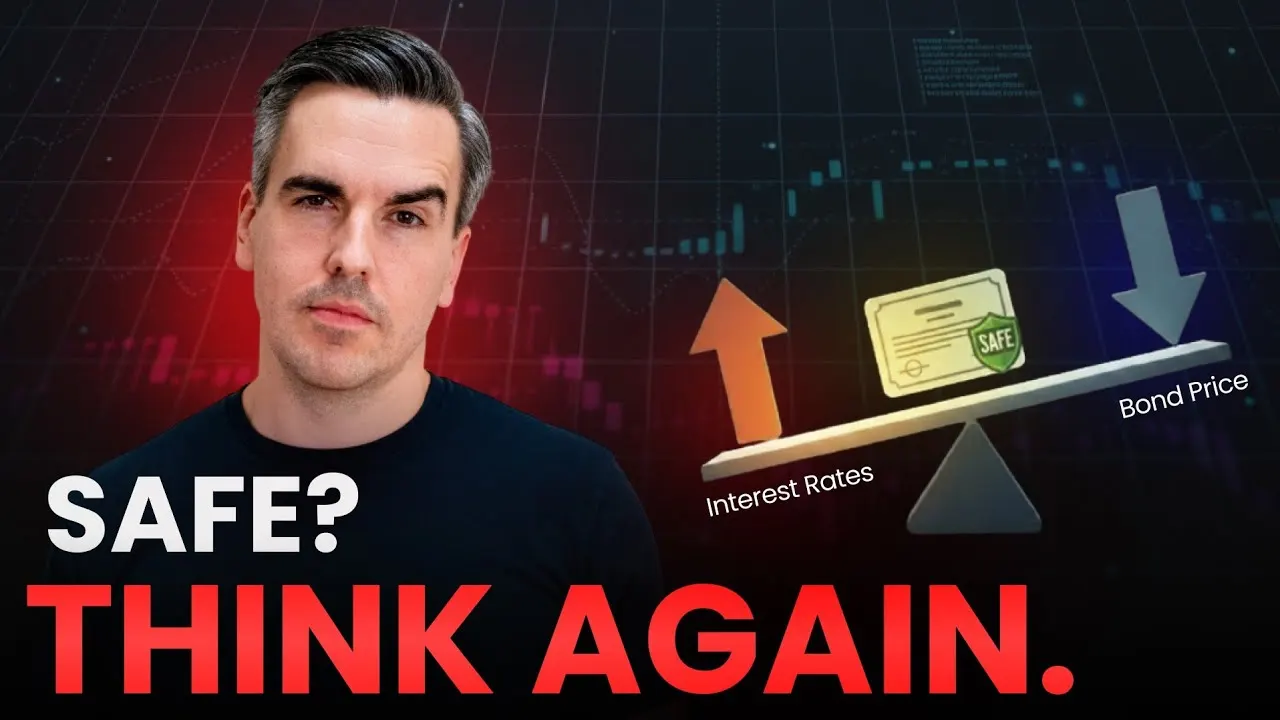
Bonds: How $17 Billion Disappeared Overnight (Safe? Think Again)
Prefer to watch? This article is the written companion to the video above.
If you want to know when the global financial system is about to crack, don’t watch the stock market. Watch the bond market.
Stocks are the show. Bonds are the wiring behind the walls. While equity investors chase headlines and memes, the bond desk is quietly reading the one thing that decides everything when it goes wrong: the legal hierarchy of who actually gets paid.
And in that hierarchy, bondholders sit near the front. In a corporate liquidation the order is strict — the tax authority first, then secured lenders, then bondholders. Shareholders stand at the very back, waiting for leftovers that usually never arrive.
But being near the front of the queue does not make you invincible. A bond has three separate risks, and the word “safe” hides two of them completely. Ignore any one, and your floor becomes a trapdoor.
First: a bond is a contract, not an investment
Strip away the jargon. A bond is not an investment in the way a startup or a tech stock is. It is a legal contract. An IOU.
When you buy one, you are the lender. You give your capital to a government or a company for a defined term, and in exchange they contractually owe you two things: coupons (your interest) and your principal back at maturity. That contractual nature is the whole point. It is what puts you ahead of shareholders, and, as we’ll see, it is also what can be used against you.
The mistake: sticker yield vs real yield
Retail investors make the same error repeatedly. They look at the sticker yield, the headline rate printed on the product. Professionals look at the real yield: interest minus inflation.
For years, real yields were negative. On paper you “earned interest”; in reality your purchasing power was quietly evaporating. (That erosion is structural, not accidental, which is exactly why the real yield and not the sticker is the number that matters.)
That has now turned. With the US 10-year Treasury around 4.6% in mid-2026 and inflation easing, a high-quality government bond can finally deliver a genuinely positive real return, so you are paid, in real terms, for holding a government contract.
That yield is also your hurdle rate — the unbribable judge. If another investment cannot beat the risk-free baseline after costs and tax, it has no economic right to be in your portfolio. (And note the hurdle moves. It was nearer 4.2% at the start of 2026. Look it up on the day you decide.)
Second: the risk nobody mentions — duration
Most people think bonds are safe because the income is fixed. But the price of a bond moves every second, and the lever that moves it is duration.
Think of a see-saw. On one side, interest rates. On the other, the bond’s price. When market rates rise, the price of your existing bond must fall, so that it stays attractive against newly issued bonds paying more. When rates fall, your bond’s price rises.
The trading-floor rule of thumb:
For every 1 percentage point rise in rates, a bond loses roughly its duration, in percent.
A bond with a 7-year duration, when rates rise 1%, loses about 7% of its value, instantly, on paper. That much most people can absorb. What almost nobody does is run the same arithmetic across the rest of the maturity range, which is where it stops being a rule of thumb and starts being alarming.
The risk the word "safe" hides
One interest-rate move, six government bonds
Every bond below is issued by the same creditworthy government. Nobody defaults, nobody misses a coupon, and every one of them repays in full at maturity. This is what happens to their market price on the day rates move.
A thirty-year government bond losing 60% is not a credit event. It is a calculator working correctly. The issuer is still good for the money, and if you hold to maturity you get every cent back.
The catch is that "hold to maturity" has to be a choice you can still make in thirty years. Sell early, or hold the bond inside a fund that has to sell, and the paper loss becomes the real one. Which is the whole argument for keeping the duration of your floor short enough that you never have to find out.
Look at the bottom row. A thirty-year government bond, the instrument a certain kind of cautious investor buys precisely because it feels like the safest thing on the menu, falls 30% on a one-point move and 60% on two. Nobody has defaulted. Nobody has missed a coupon. The issuer is exactly as creditworthy on the way down as it was at the top.
This is why a “safe” long-dated government bond can fall further in a year than many stocks. It is precisely the mechanism that nearly broke the UK pension system in 2022, and the reason that episode is worth studying is that the institutions involved were not reckless. They were doing the textbook thing, at scale, with the duration nobody had thought to check.
The part that catches people out: a bond and a bond fund are different animals
This is the single most useful thing in this article, and it is almost never explained properly.
A bond has a maturity date. If you hold it to that date and the issuer pays, you get your principal back in full. Every wobble in the price between now and then is noise you can choose to ignore, because there is a date on which the contract settles and the market’s opinion stops mattering.
A bond fund has no maturity date. It is a rolling portfolio: as bonds inside it approach maturity they are sold and replaced with new ones, so the fund’s duration stays roughly constant forever. There is no date at which you are made whole. The price is the price.
That difference is invisible in normal conditions and decisive in bad ones. Someone holding a five-year government bond through 2022 watched the price fall, kept collecting coupons, and got their money back on schedule. Someone holding a long-dated government bond fund through 2022 took a loss that had no expiry date attached to it — and their only route back was for rates to fall again.
Neither instrument is wrong. Funds are cheap, diversified and vastly more practical for most people, and I hold them. But if you are using bonds as a floor, you should know which of the two you actually own, and you should know the number that decides how hard it can fall.
Where to find it: every bond fund publishes its effective duration on the factsheet, usually one line under the yield. It is a single number in years. Multiply it by the rate move you think is possible, and you have your answer before the market gives you one.
The professional’s shock absorber: convexity
Duration assumes a straight line. The real relationship is a curve, and convexity measures the curvature.
Positive convexity helps you at both ends:
- When rates fall, your price rises a little faster than duration predicts, which is a turbo.
- When rates rise, your price falls a little slower, which is a brake.
In volatile markets, professionals hunt not just for yield but for solid positive convexity, because it turns a bond from a passive income stream into a structural stabiliser for the whole portfolio. It also means the ladder above is slightly harsher than reality, and deliberately so: if you plan around the straight line, the curve can only surprise you pleasantly.
Third: the day the queue broke
We established that bondholders have priority. They are paid before shareholders. That is a foundational pillar of finance, until March 2023.
Credit Suisse. A 167-year-old institution, a symbol of Swiss stability, spiralling toward a forced rescue by UBS. The usual script says shareholders are wiped out first, and bondholders take losses only after the equity is gone. That is not what happened.
The Swiss regulator, FINMA, invoked an exceptional clause in the bond documentation, combined it with emergency resolution powers, declared a “viability event”, and wrote roughly CHF 16 billion (about $17 billion) of Additional Tier 1 bonds down to zero. The shareholders, last in line, received UBS shares. The AT1 bondholders got nothing.
The queue was inverted.
This was not a market crash. It was a prospectus and resolution event — the vault opened from the inside, under stress, using tools most investors never knew existed. And it taught one permanent lesson:
Your priority is only as strong as the exact legal wording, and the regulatory powers sitting on top of that contract.
(The full anatomy of that wipeout, and how to check whether a bond ETF you own holds these instruments, is its own story.)
The takeaway for a private investor is blunt: stay away from complex hybrids like AT1s. If you want bond exposure to act as a true floor, focus on senior, high-quality, investment-grade and government debt, where the legal waterfall is still clean and well-tested.
Where the real money is made or lost: the credit spread
When you lend to the US government, you get the risk-free rate. When you lend to a company, you should demand a bonus for the risk it goes bust. That bonus is the credit spread, and right now it is flashing a warning.
The credit spread
What you are paid for the risk you are taking
Lend to a government and you get the risk-free rate. Lend to a company and you should get a bonus for the chance it goes bust. This is the size of that bonus, in basis points of extra yield.
Close to the tightest in about 25 years.
What lending to companies has typically paid.
The default risk has not halved. The payment for carrying it has.
That is the asymmetry: roughly half a percentage point of extra annual yield on offer, against a price fall that arrives in full the moment the market decides companies are riskier than it thought. Spreads widening back to their own long-run average would do that on its own, with central bank rates completely unchanged.
In mid-2026, investment-grade spreads were near 77 basis points, close to the tightest in about 25 years, against a long-run average around 150. You are taking corporate default risk, and the market is barely paying you for it.
That is not only my reading of a data series. The Federal Reserve’s own Financial Stability Report of May 2026 put it in the flattest possible language: spreads over Treasuries “remained at the low end of their historical range”, and the excess bond premium, which strips out credit quality and bond characteristics to isolate what investors are being paid purely for bearing risk, “continued to edge down and remained below the median of its historical distribution”. When the central bank writes that in its financial stability report, it is describing the same thing the desk sees on the screen.
If a recession hits and spreads widen back toward normal, corporate bond prices fall even if interest rates themselves do nothing. The trading floor calls this asymmetric risk. When you are building a floor, this is not the moment to stretch for a little extra yield in corporate or high-yield debt. It is the moment to let high-quality government bonds do the heavy lifting.
How to actually use bonds
Modern practice does not buy bonds for “income” any more. It buys them as volatility dampeners and rebalancing ammunition.
In a real crisis, equities crash and central banks often respond by cutting rates, which pushes high-quality government bond prices up. That price spike is your dry powder: you sell some of the now-expensive bonds to buy the cheap equities everyone else is dumping. Bonds are simultaneously your defence and, through rebalancing, your opportunity.
A practical rulebook:
- Age and horizon. Under 40 with a long horizon, your equity risk premium dominates; heavy bond exposure in a taxable account is often unnecessary. Approaching retirement, bonds become the tool that controls volatility and protects your withdrawal path.
- 80/20 as a starting frame. Roughly 80% equities as the engine, 20% bonds as the mathematical floor. The exact split follows your risk tolerance. The principle does not: stocks are the engine, bonds are the stabiliser.
- Control your duration. Don’t play hero with 30-year bonds you don’t need. In a world of volatile inflation and policy shocks, short-to-intermediate duration of roughly 1–5 years avoids the extreme swings that hit long-dated debt. Check the factsheet rather than guessing.
- Audit the credit. With spreads this tight, this is not the time to chase 2% extra in junk. A boring, high-quality government bond is a far more reliable floor than a glamorous high-yield product that drops like a stock in a downturn.
- Mind the tax. Interest income is often taxed less favourably than long-term equity gains. Hold bond exposure inside tax-advantaged retirement accounts where you can.
Floor or trapdoor
Bonds can be the floor under your portfolio, but only if you respect what they actually are. Legal contracts with a specific place in the capital structure. Mathematical interest-rate exposure through duration. And real-world credit risk through the spread.
Respect all three, and they are the stabiliser that keeps the ship upright when the storm hits. Ignore any one, reach for yield in junk, ignore duration, buy when the spread pays you nothing, and the same asset class becomes the trapdoor you thought you were standing on.
The safety was never in the label. It was in the structure underneath it.
Educational content only — not investment advice, and not a personal recommendation. Yields and spreads quoted are point-in-time and move daily; check the current figures before acting. Speak to a qualified, licensed professional.
Keep going
Finished reading? Three places to go next
- Go deeper · researchWhy US bond yields rose in 2026 Research note: six explanations for this year’s rise, each tested against public data.
- Next in Which Asset Class Is For You? · episode 4Index Funds vs Active Funds: 98% Lost to Their Index Over ten years, 98.44% of euro-denominated global equity funds lost to their index. That is S&P's own scorecard — so what is still worth paying for?
- On YouTubeSubscribe on YouTube (opens YouTube in a new tab)New videos every Tuesday: one money question per episode, checked against the data.
Primary sources (4)
- 01ICE BofA US Corporate Index Option-Adjusted Spread — investment-grade credit spread, daily — Federal Reserve Bank of St. Louis (FRED) / ICE BofA
- 02Market Yield on U.S. Treasury Securities at 10-Year Constant Maturity (DGS10) — Federal Reserve Bank of St. Louis (FRED)
- 03Unlawful write-off of AT1 capital instruments — judgment of 1 October 2025 — Swiss Federal Administrative Court (BVGer)
- 04Financial Stability Report, May 2026 — Asset Valuations: corporate bond spreads "remained at the low end of their historical range"; the excess bond premium "remained below the median of its historical distribution" — Board of Governors of the Federal Reserve System
Questions people actually ask
Are bonds actually safe?
They are safe from the specific risk they are sold for: a high-quality government bond will pay your coupons and return your principal at maturity. That is real, and it is why bonds sit near the front of the repayment queue. But 'safe' hides two other risks entirely — the price moves with interest rates (duration), and the extra you earn for lending to a company can vanish (the credit spread). A bond used without respecting those is not a floor. It is a trapdoor.
What is a bond, really?
A legal contract — an IOU. When you buy one, you are the lender: you hand capital to a government or company for a defined term, and in exchange they contractually owe you coupons (the interest) and your principal back at maturity. That contract also fixes your place in the queue if the borrower fails: after the tax authority and secured lenders, but ahead of shareholders. It is the contractual nature, not any inherent safety, that matters — as the Credit Suisse case showed brutally.
What is the difference between sticker yield and real yield?
The sticker yield is the headline number printed on the bond. The real yield is that number minus inflation — what your purchasing power actually does. For years real yields were negative: you 'earned interest' on paper while your money lost ground. That has changed. With the US 10-year Treasury around 4.6% in mid-2026 and inflation easing, a high-quality government bond can now deliver a genuinely positive real return — the first time in a long while that lending to a government pays you in real terms.
What is duration, and why does it matter?
Duration measures how much a bond's price moves when interest rates change. The trading-floor rule of thumb: for every one percentage point rise in rates, a bond loses roughly its duration, in percent. A bond with a 7-year duration loses about 7% of its value if rates rise 1% — instantly, on paper. This is why a 'safe' long-dated government bond can fall further in a year than many stocks, without anyone defaulting. It is also exactly what nearly broke the UK pension system in 2022.
What is convexity?
Duration assumes a straight line; the real relationship between rates and price is a curve, and convexity measures that curvature. Positive convexity works in your favour at both ends: when rates fall, your bond's price rises a little faster than duration alone predicts, and when rates rise, it falls a little slower. It is a mathematical shock absorber with a mild turbo. Professionals in volatile markets hunt not just for yield but for solid positive convexity, because it makes a bond a structural stabiliser rather than just an income stream.
What happened with Credit Suisse bonds?
In March 2023, the Swiss regulator FINMA wrote roughly CHF 16bn (about $17bn) of Credit Suisse's Additional Tier 1 (AT1) bonds down to zero — while shareholders, who normally lose everything first, received UBS shares. It inverted the queue. The mechanism was not a market crash but a clause in the bond documentation combined with emergency resolution powers: a 'viability event'. The lesson for bondholders is permanent — your priority is only as strong as the exact legal wording and the regulatory powers sitting on top of the contract. The full story is worth reading separately.
Should retail investors buy AT1 or high-yield bonds?
For most people, no — not as the 'safe' part of a portfolio. AT1s are complex hybrid instruments whose priority can evaporate through a prospectus clause, as Credit Suisse holders discovered. High-yield ('junk') bonds behave like equities in a downturn, falling hard exactly when you wanted your floor to hold. If you want bonds to act as a genuine floor, that job belongs to senior, high-quality, investment-grade or government debt, where the legal waterfall is clean and well-tested. Nothing here is a personal recommendation.
What is a credit spread, and why is it a warning right now?
The credit spread is the extra yield you demand for lending to a company instead of to the government — your compensation for the risk it goes bust. In mid-2026, investment-grade spreads were near 77 basis points: close to the tightest in about 25 years, against a long-run average around 150. In plain terms, you are taking corporate default risk while barely being paid for it. If a recession widens spreads back toward normal, corporate bond prices fall even if interest rates do nothing. That is asymmetric risk: small extra reward, large potential downside.
How should bonds actually be used in a portfolio?
Modern practice treats them less as income and more as two things: a volatility dampener and rebalancing ammunition. In a crisis, equities crash and central banks often cut rates, which pushes high-quality government bond prices up — turning them into dry powder. You sell some of the now-expensive bonds to buy the cheap equities everyone else is dumping. Bonds are simultaneously your defence and, through rebalancing, your opportunity. That is a different and more useful role than 'the boring bit that pays interest'.
How much of my portfolio should be in bonds?
It depends heavily on your age, horizon and tax situation, so treat any single number as a starting point rather than an answer. A common frame is roughly 80% equities as the engine and 20% bonds as the mathematical floor, tilted toward more bonds as you approach the years when a crash could force you to sell. Two refinements matter: keep duration short-to-intermediate (roughly 1–5 years) to avoid the violent swings of long-dated debt, and hold bond exposure inside tax-advantaged accounts where possible, since interest is often taxed less favourably than long-term equity gains. This is a framework, not advice.
So are bonds a floor or a trapdoor?
Either, depending entirely on whether you respect what they are. Used correctly — high quality, sensible duration, priced when the spread pays you — they are the stabiliser that keeps a portfolio upright in a storm. Used carelessly — reaching for yield in junk or hybrids, ignoring duration, buying when spreads are at 25-year tights — the same asset class becomes the trapdoor you thought you were standing on. The safety was never in the label. It was in the structure underneath it.