Warren Buffett's Investment Strategy: The Part You Can't Copy
Philipp 13:23 Episode 5 of Ask a Banker
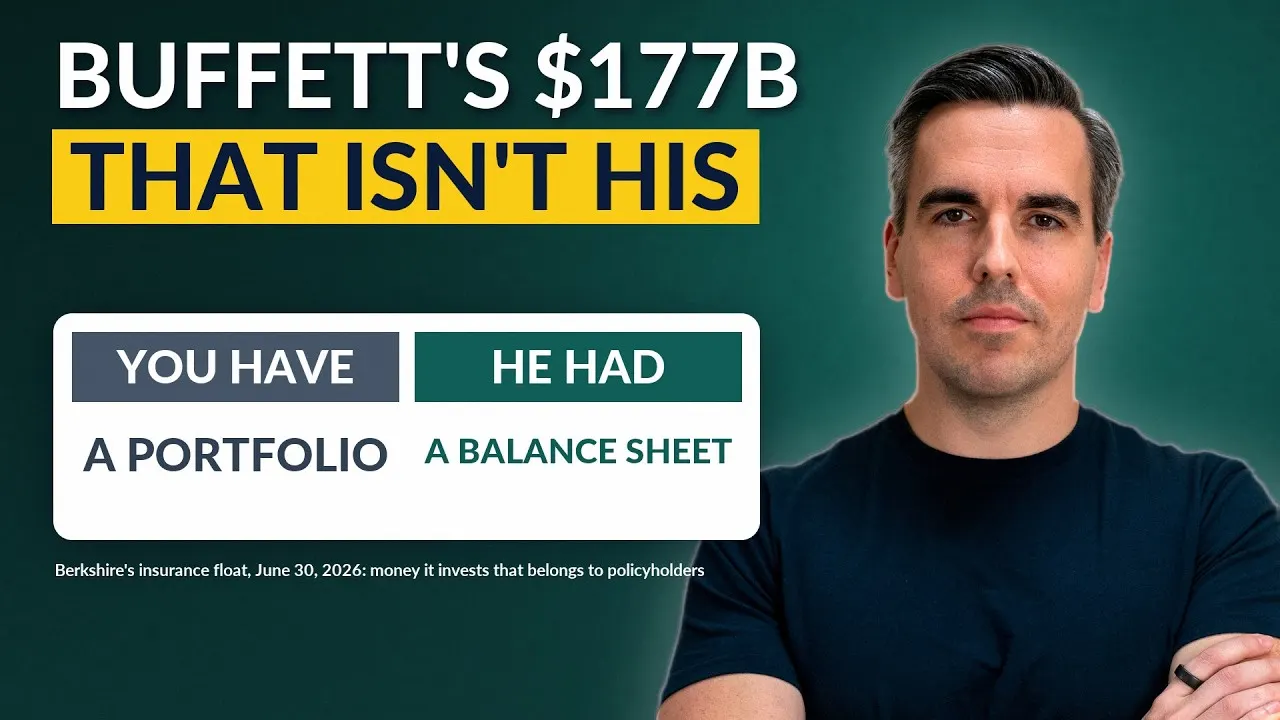
Warren Buffett's Investment Strategy: The Part You Can't Copy
Transcript
The spoken text of the video, published November 3, 2026, lightly edited for reading. Where the video and the article differ, the article is the checked version.
Should you invest like Warren Buffett? Here’s the number that decides it. Berkshire invested 177 billion dollars of cash that wasn’t its own. Nobody can call it back on short notice, and in most years it has cost less than nothing. Which is why the stock picks were never the interesting part. You have a portfolio. He had a balance sheet. And by the end I’ll show you where the man himself wrote down a different answer, for his own family’s money.
There is a number that shouts yes, do it just as Warren Buffett does, and a word that says no. Neither of them is stupid. The number first: 60 years of investment history, 19.7% a year against only 10.5 for the S&P 500 with dividends included, positions published the whole way, thinking explained in writing. He proved it. It worked. And the word: survivorship. One winner out of thousands, explained backwards.
[Note: The checked figures are 19.7% a year for Berkshire and 10.5% for the S&P 500 with dividends. The recording may sound slightly different.]
And I’ll be honest. For years I was on the side of the number. I read Buffett’s letters, I followed his trades. It was fascinating, and it took me embarrassingly long to notice that I was studying the wrong half of the company. The number is right about the math, the word is right about the odds, and both of them are arguing about the stock picks, which is the part that doesn’t explain the returns at all.
Copying Berkshire’s trades feels possible for a good reason: Berkshire is legally required to publish its US stock holdings. And half of the internet has the list up within an hour. So look at what the list actually is. First of all, it’s late. The deadline is 45 days after the quarter ends, and if he asks for confidential treatment, it can be up to a year. Which is how he sat on $4.5 billion of Chubb for months before anyone outside the company knew about it.
And the list is partial: long positions in US stocks and one single day of the quarter. And none of the businesses Berkshire owns outright. The railroad, the insurers, the manufacturers, that’s where most of the operating profit is actually made. An incomplete list, at least six weeks old, of the smaller half of what Berkshire actually owns.
So how does a banker actually take that return apart? Not by what somebody bought, but by what they bought it with. You invest money that belongs to you. The market goes up by 10% and you made 10%. That’s the whole equation. Berkshire didn’t. And that’s the sentence it all hangs on. You have a portfolio. He had a balance sheet.
Berkshire is, before anything else, an insurance company. Premiums arrive today, claims get paid out over years, and in between there’s a pile of money just sitting there. Insurers call it “float.” Today it’s 177 billion dollars.
And now this is what it costs him, with the condition he attached, because this part matters. In the years the insurance business earned an underwriting profit, which was most of the time, he stated: “Our cost of float was less than zero.” So, not cheap borrowed money. Borrowed money he even got paid to hold. When researchers took it apart over 40 years, for every dollar of his own, roughly 70 cents belongs to somebody else. And it cost him about three points less than what the US government itself paid to borrow short term. There is no account and no broker on earth that gives you this condition.
And Warren Buffett didn’t buy at the prices you buy either. Goldman Sachs, September 2008, the great financial crisis. $5 billion at 10%, guaranteed, plus the right to buy 43 million shares at a fixed price. That was not on anybody’s brokerage platform. It was offered to Buffett because he was the one who could sign that check that week.
And the best part of Berkshire’s conditions: nobody can pull their money out of Berkshire the way they can out of a fund. Which is why the moment everyone else on the street was being forced to sell was the moment he was free to buy.
Now put all that together and measure what’s left. Take out the cheap money, take out the kind of companies he bought, the steady, high-quality, low-drama ones, and the extra return on his public stock portfolio, the exact part you can copy, then the rest comes down to 0.3 percent. That’s basically a rounding error. The part you can see is the part that adds almost nothing.
Now the fair question, and probably the one you’re sitting on. No float, no call from Goldman Sachs, fine, but the list is still public, so why not just buy what he buys a month after he tells me?
Well, somebody actually measured the exact thing. A study of Berkshire’s disclosed holdings found that a portfolio buying those positions only after they went public beat the S&P 500 by about 10% a year. And Berkshire’s own equity book beat that index in 27 of 31 years.
[Note: The study’s figure is 10.75 percentage points a year.]
Okay, okay, wait. This is a serious finding, and I’m not going to talk you out of it with an opinion. Two things: it is only a working paper, never peer-reviewed, and it runs from, hold on, 1976 to 2006. That’s 20 years ago. But this is the part that makes it different from most investing arguments: it didn’t stay on paper. People built real funds on it, with real money and real fees, and we can go and look up exactly what happened.
June 2012: Global X launches the Guru Index ETF. Its own prospectus describes the method: read the 13F filings, buy the top holdings, rebalance every quarter. Precisely the idea. And it’s still trading today. Over the 10 years to the end of 2025, from its own prospectus table, it returned 11% a year. That’s good, right? The S&P 500 did 15 points. $10,000 turned into about $28,000, but in the index just under $40,000. Same decade, same starting point, and roughly $11,000 apart.
[Note: The checked figures are 14.8% a year for the S&P 500, and about $28,500 for the fund against just under $40,000 for the index.]
Days before that, AlphaClone launched a version that was clever about it, or at least it looked clever on paper, because it scored the managers first and followed only the ones with the best record. Launch to the end of 2021: 12.85% a year against 17 points. Liquidated in August 2022.
[Note: The checked figure for the S&P 500 over that period is 16.68% a year.]
Another example, 2014, Direxion: the 13F filings of billionaire investors, 30 stocks, equally weighted. Launch to the end of 2017, 8 percentage points against 12. Shut down four months later.
[Note: The checked figures are 8.46% a year against 12.33%.]
So three funds, three different sponsors, and three completely different stretches of the market. All three land behind the index. And it wasn’t three attempts either. Global X ran three more versions of the same idea. All three closed, one of them within a year. That’s six funds shut down in this category.
[Note: In the recording this can sound as if all three closed within a year. The small-cap version closed after about a year; the international and activist versions closed in October 2017. The sixth closure is AlphaClone’s international fund, in June 2018.]
Now let me be straight about the limit of this. None of them copied Berkshire specifically. They copy baskets of hedge funds. There is exactly one fund that does the Berkshire-only version, launched in March 2025, and it has already pulled in over a billion dollars of cash with no track record worth reading. The idea sells. That was never the question. So nobody has run that version long enough to know. What we do know is that every single time somebody built the general version and put real money behind it, it has lost to the index.
So why the shortfall? Every time. Fees are part of it. Global X charges 0.75% a year, but the gap is nearly 4%. The rest is everything we just walked through: a stale list, prices that already moved, and no balance sheet underneath it.
[Note: The checked gap is 3.79 percentage points a year.]
Now the question underneath all of this, and it decides how much this matters to you: does the machine still run? Because if it does, then everything I just said is a detail. People skip this one because it sounds disrespectful.
Over the last 10 years, Berkshire returned 14.3% a year. The S&P 500 returned 14.8, so it lagged. And over 20 years it’s a head-to-head race: 11.3 to 11. That isn’t decline, and it isn’t a scandal either, it’s arithmetic. And Buffett called it himself in 1994, when Berkshire’s net worth was around 12 billion dollars rather than 720. He said, “The future performance of Berkshire won’t come close to matching the performance of the past.” And in the same letter: “A fat wallet is the enemy of superior investment results.”
[Note: The 1994 letter gives Berkshire’s net worth as $11.9 billion. Its sentence reads in full: “A fat wallet, however, is the enemy of superior investment results.”]
But size is only half of it. In 2023, he described what was actually left to buy. Only a handful of companies in the US big enough to move the needle at Berkshire. And those, in his words, not mine, had been “endlessly picked over by us and by others.” Picked over. That’s 40 years in two words.
So here’s my reading on all of that. He built that record decades ago, in a market that was anything but perfect. There was huge information asymmetry. Quality was cheap because nobody could measure it, or nobody tried. But today, quality is a product. You can buy it in a fund for a few basis points, precisely because people like him proved it worked. The edge didn’t get stolen, it just got packaged and sold back to you. So 19.7% a year isn’t some formula still quietly running in Omaha. It’s the record of a machine that ran in a market that doesn’t exist anymore.
Okay, so what can we actually take away from that? Something real. Berkshire has fallen roughly 50% three times in 60 years, and he didn’t sell. Which cost nothing, and it’s the exact thing private investors statistically fail at.
And one more thing, because it changes the question. Since the 1st January of 2026, Warren Buffett is not the chief executive at Berkshire Hathaway anymore. Greg Abel is. Buffett is 96, still chairman, still the largest shareholder. Which matters less than you’d think. What people are trying to copy was never the job title. It was the balance sheet.
Coming back to the whole question: should you invest like Warren Buffett? Not in the way you mean it. Well, you can copy the list, but you can’t copy the balance sheet, you can’t copy the terms, and you can’t copy 60 years of never having to hand the money back. But yes, the other half, the patience and the practice, that’s the bigger half, and you can copy that.
And one more super interesting point in the finale. Here is what he wrote down himself. His 2013 letter set out the instructions in his will for the cash he leaves to a trust for his wife. I quote: “Put 10% of the cash in short-term government bonds and 90% in a very low-cost S&P 500 index fund.” He wrote S&P 500 because he’s American. The point isn’t the index. It’s that the most admired investor of the last 60 years, writing down what happens to his own family’s money, chooses a fund over his own company.
Okay, three things to take away, and one note: this is education, not financial advice. Your situation is yours.
First, if you read a 13F filing, read the date first. You’re not buying the decision, you’re buying its aftermath.
Second, the one thing that genuinely transfers is the holding period. Before your next sale in a falling market, one question: has the business changed, or only the price?
Third, run on yourself the same test those funds failed. Your own return over the last three years, set against the plain world index over the same period, both including dividends. Every fund in this episode published that comparison. Most private investors never make it.
So his edge was never the list. It was 60 years of investing other people’s money at a price nobody else was offered, in a market that rewarded exactly that, and never once being forced to hand the money back. So you have a portfolio, and Warren Buffett had a balance sheet.
He wrote “index fund,” which raises the next question: should you still just buy the S&P 500? That’s next. I’m Philipp. Stay skeptical, and see you on the next one.
You can copy Warren Buffett's stock list from his 13F filings. It won't get you his returns: Berkshire invested about $177.5 billion of insurance float that isn't its own. Episode 5 of Ask a Banker.
Read the written version
How to Invest Like Warren Buffett: The Part You Can Actually Copy
You can copy Warren Buffett's stock list, but not the machine behind his returns. Berkshire invested insurance float, about $177.5 billion on June 30, 2026: money it holds for policyholders, cannot be asked to repay on short notice and that in most years cost it less than nothing. Researchers estimate Berkshire's average leverage at about 1.7 to 1, at a float cost of 1.72% a year (October 1976 to March 2017). Once the type of company Buffett bought is controlled for (low-risk, high-quality stocks), the alpha of Berkshire's public stock portfolio, the part a 13F filing shows, falls to 0.3% a year, which cannot be statistically distinguished from zero. Three ETFs built on 13F filings trailed the S&P 500 by 3.79, 3.83 and 3.87 points a year over their windows. What a private investor can copy is the behavior: holding through large falls, and checking their own results against a broad index fund, which is what Buffett instructed for the cash he leaves to a trust for his wife.
Full article, with the sources and the numbers →
More from Ask a Banker
-
 Should You Buy a Rental Property? (Real Estate vs Stocks) Episode 1 · 12:30
-
 The Worst Month for Stocks Isn't October (Data Since 1928) Episode 2 · 12:07
-
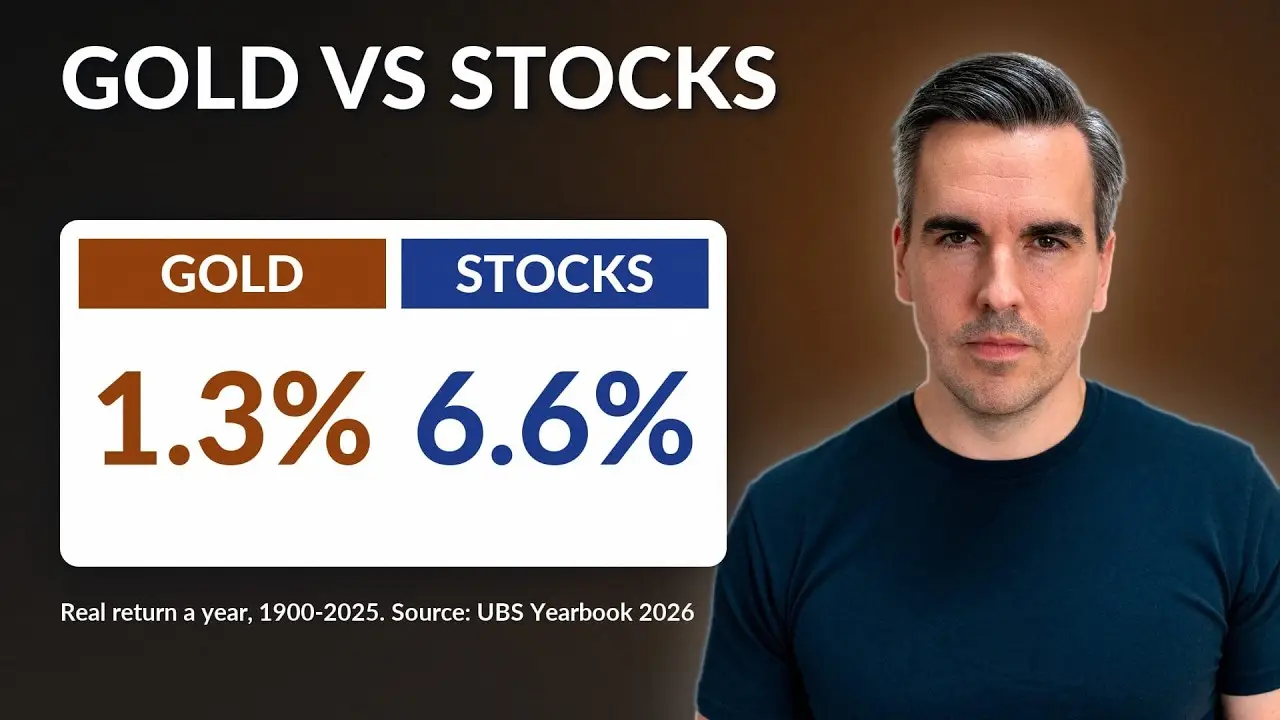 Is Gold a Good Investment? Central Banks' Reason Isn't Yours Episode 3 · 12:02
-
 Live Off Dividends: How Much You Need Invested for $2,000 a Month Episode 4 · 8:48
-
 The S&P 500 Isn't as Diversified as You Think (It Acts Like 48 Stocks) Episode 6 · 12:47