Live Off Dividends: How Much You Need Invested for $2,000 a Month
Philipp 8:48 Episode 4 of Ask a Banker
Live Off Dividends: How Much You Need Invested for $2,000 a Month
Transcript
The spoken text of the video, published October 27, 2026, lightly edited for reading. Where the video and the article differ, the article is the checked version.
Can you actually live off dividends? $100,000 in a broad S&P 500 fund pays you about $1,100 a year in dividends, before tax. The number isn’t small because the index is stingy. It’s small because you’re only looking at one slice of what you’re actually getting paid. The dividend isn’t the payment, it’s the part of the payment you can actually see. And by the end of this video I’ll give you the one number that tells you whether a dividend is a fact or a forecast.
Ask that and you get two answers that never quite meet. One says it’s real money. It lands in your account every quarter. You didn’t sell anything to get it, and nobody can take it away from you. The other says it’s your own money handed back to you, because the company had cash, and now you have the cash, and the share price, well, dropped to match.
Both are true. And I get the first one, I really do. There is something about money arriving in your account without you doing anything for it that feels different from a number on the screen going up.
But notice what those two answers are actually arguing about. It’s the wrong question: they’re arguing about whether the dividend is real, and that question decides nothing. The one that decides everything is what it costs you and what it buys you.
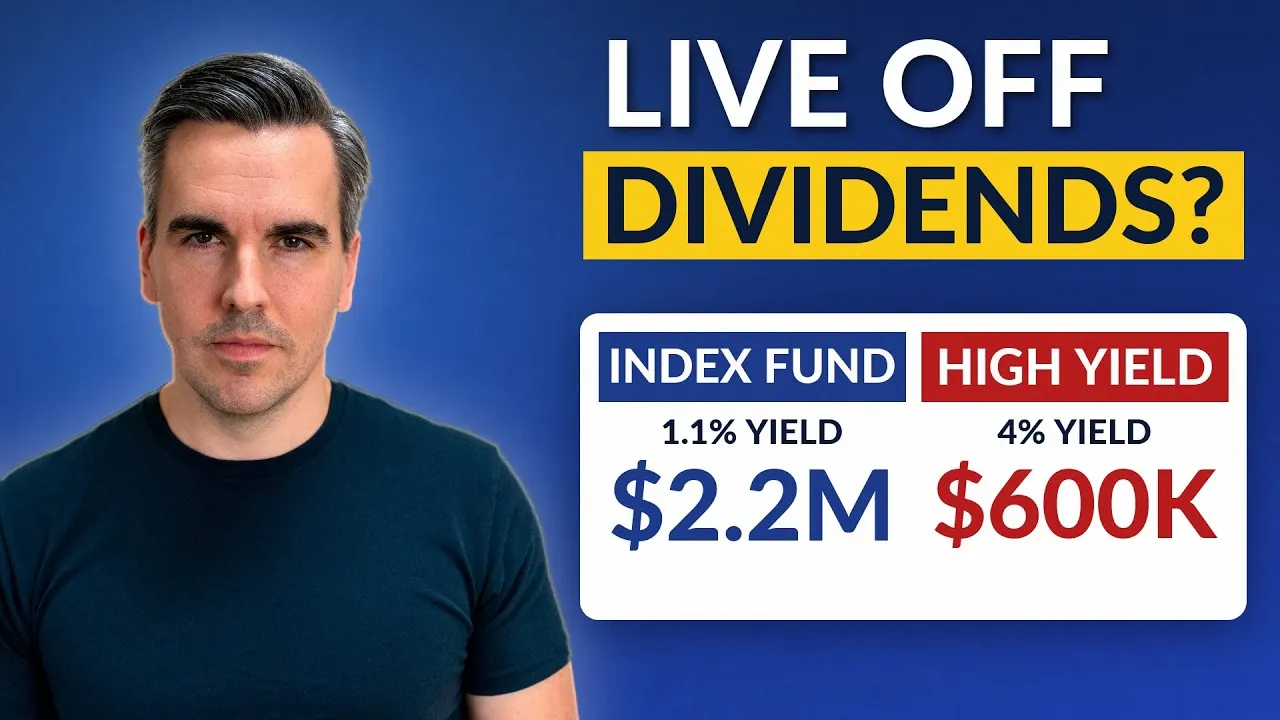
Because the promise attached to dividends is a big one: passive income. Live off the dividends and never touch the shares. So, let’s price it. 2,000 a month is 24,000 a year, and the index yields about 1.1%, so you need more than 2 million dollars to get there, about 2.2 if you want to be exact. At a high-dividend fund yielding around 4%, that’s roughly only 600,000. Those aren’t two versions of one plan, they’re two completely different plans. And most people never notice which one they picked. The first one is building a portfolio. The second one is buying a 4% yield. And that’s where the risk lives.
So, how does a banker look at what the company pays its owners? Not at the dividend, at the whole payout. There are two ways a company hands you money. A dividend, where cash leaves the company and arrives in your account. And a buyback, where the company buys back its own shares. When the share count actually falls, your slice of the company gets bigger. Both are the company handing money back to its owners, just through a different door. And only one of those doors opens somewhere you can see it.
So, if you already own a broad index fund, here is the good news, and it really is good news: you’ve been getting the second one all along. You just never saw the transfer.
You know, in the boardroom, your dividend is actually kind of the residual. Nobody in that room says dividend or buybacks. It’s about the company’s long-term strategy, what the shareholders expect and how to get it back to them, through one door or another.
And the invisible door is the bigger one. Over 12 months, the S&P 500 companies handed their owners about 1.7 trillion dollars, and only about 40% of that arrived as dividends. The rest, more than 1 trillion, went out as buybacks. [Note: the 12 months to September 30, 2025, according to S&P Dow Jones Indices.] And that’s not a one-off. So that $1,100 isn’t what the S&P 500 paid you, it’s what it paid you where you can see it.
Now the part most videos get wrong. On the ex-dividend day, the price of your stock drops by roughly the dividend, and you’ll hear people say it drops by exactly the dividend. Which it doesn’t. It’s usually a little less, but honestly, that’s a footnote. What isn’t a footnote is this: a dividend doesn’t create wealth. It converts a slice of what you already own into cash. The dividend isn’t the payment, it’s the part of the payment you can see.
So, is it pointless? No. This is where the skeptics overreach. Start with what the dividend investors are right about. In the first half of 2020, a rather interesting year for the markets, 62 S&P 500 companies cut their dividend, and 41 of those stopped paying altogether. And the index dividends still finished the year at a record. If you owned the index, your income didn’t fall. If you owned the five high-yielders, well, it could have gone to zero. That’s not an argument for dividends, it’s an argument for owning a lot of them.
Second, and the skeptics skip this entirely: the cash arrives in your account without you deciding anything, and in a falling market, a dividend that hasn’t been cut doesn’t ask you to sell more shares to raise the same money. A sale does. And a falling market is exactly where decisions go wrong.
But here’s the honest limit. Over the past decade, the Dividend Aristocrats made about 10% a year, while the broad market did about 5 points more a year. And the gap is a decade, not a law. Measured over 20 years, the two have finished within a fraction of a point of each other. So why the gap in the last decade? Well, because it was a technology decade, and high-dividend strategies hold almost no technology. Take a large US high-dividend fund. Roughly 3% of it is technology, against about 38% in the broad market. [Note: fund weights from the fact sheets used for the video; on September 30, 2026 they were 3.5% and 39.7%.] You’re not buying higher returns, you’re buying a different market, often a calmer ride, and a spending routine.
You know what? This is my personal view. If a dividend habit is what keeps somebody invested through a bad year, that habit is worth real money. Just know that this is what you’re paying for: not extra return, a routine that you can live with without doing anything for it.
Can you live off dividends? Yes, if the portfolio is large enough. The dividend was never the hard part, the portfolio behind it is, which leaves the question that actually decides it: is this a good way to build that portfolio in the first place? It will not reliably give you higher returns. On the best evidence available, extra return is simply not what you’re buying. But yes, it can be worth it, if you want cash that doesn’t require a decision, if you know you’re betting away from technology, and if you judge the whole thing on total return rather than the income.
And a hard no to the version that does real damage: scrolling a list of yields and buying the biggest number on it. So here’s the number I promised you. Across the highest-yielding stocks, the dividend eats around 70% of company earnings. In the group just below them, about 50. [Note: large US stocks in the Russell 1000, averages for 1983 to 2025, according to Hartford Funds and Wellington Management, a fund company’s publication.] Same market, same period. The gap is the difference between a dividend that’s a fact and one that’s a forecast. And a company that stops paying has historically dropped around 7% in three days. If you want one calm answer to one question, subscribe. That’s the whole idea of this series.
Three things to take home, and a quick note before, because it matters: this is education, not financial advice, and your situation is yours. So, first, before you buy anything for its yield, look up the payout ratio. A very high one, say about 70% of earnings, does not mean a cut is coming. It means there’s less room when earnings fall, and that’s worth knowing before the yield is.
Second, put your dividend fund’s 10-year total return next to a plain global index fund, same window, both including dividends, because that’s the only comparison that tells you what the income costs you. If you still want it after that, keep it, but do it knowingly.
If what you actually want is a monthly cash-out rather than dividends specifically, selling a small fixed percentage of a broad fund gets you the same money, and you choose the timing. With one honest trade-off: in a falling market you’re selling more shares to raise it.
Dividends are real money, they’re just not extra money. They’re the visible slice of a bigger payment, and the question was never whether the dividend is real. It’s what you give up in order to see it.
And speaking of refusing to pay one, the most admired investor of the last 60 years spent decades refusing to pay a dividend at his own company. Whether you should invest like Warren Buffett is the next question I’m answering. I’m Philipp, stay skeptical, and see you in the next one.
$100,000 in a broad S&P 500 fund pays about $1,100 a year in dividends. What $2,000 a month really takes, and why the dividend is only the part of the payment you can see. Episode 4 of Ask a Banker.
Read the written version
Dividend Investing: Can You Live Off Dividends?
You can live off dividends if the portfolio is large enough, and the portfolio is the hard part. At the S&P 500's dividend yield of 1.12% (June 30, 2026), $2,000 a month before tax takes more than $2 million; at a high-dividend fund's 4.07% (August 13, 2026), about $590,000, but that second plan buys a narrower market with almost no technology. A dividend is not extra money: on the ex-dividend day the share price falls by about the amount paid, and in the 12 months to September 30, 2025, dividends were only 39.5% of the $1.685 trillion that S&P 500 companies paid their owners; the rest went out as buybacks. Judge a dividend strategy on total return, look up the payout ratio before buying anything for its yield, and own many payers rather than a few.
Full article, with the sources and the numbers →
More from Ask a Banker
-
 Should You Buy a Rental Property? (Real Estate vs Stocks) Episode 1 · 12:30
-
 The Worst Month for Stocks Isn't October (Data Since 1928) Episode 2 · 12:07
-
 Is Gold a Good Investment? Central Banks' Reason Isn't Yours Episode 3 · 12:02
-
 Warren Buffett's Investment Strategy: The Part You Can't Copy Episode 5 · 13:23
-
 The S&P 500 Isn't as Diversified as You Think (It Acts Like 48 Stocks) Episode 6 · 12:47