Research project
Rates, Debt and Inflation: Testing What Everyone Says
We test common claims about interest rates, debt and inflation against public data and date every verdict. Notes so far: US yields in 2026, who paid for inflation.
In this project
Research note · October 2026
Who Paid for Inflation? Savers, Borrowers, Banks and Government
With US inflation at 3.4 percent in August 2026: who paid for the last round, and who gained? Six claims about savers, borrowers, banks and the Fed, tested.
- 1 × holds
- 3 × half true
- 1 × doesn’t hold
- 1 × can’t be settled
Read the note →
Research note · October 2026
Why US Bond Yields Rose in 2026: Six Explanations Tested
Six explanations for the 2026 rise in US Treasury yields, tested against public data: inflation, the Fed, debt, term premium, a global move and AI.
- 1 × holds
- 2 × half true
- 2 × doesn’t hold
- 1 × can’t be settled
Read the note →
Philipp Misura · ProfitOwl Research · October 2026
Most of what people say about rates, debt and inflation isn’t wrong. It’s undated.
“Rates are high because Washington borrows too much.” “Inflation is back.” “The Fed did it.” You hear these claims on the news, from friends and in our own comment section. Each one sounds right. Each one is right somewhere, for some window. This project takes them one at a time, finds the public data series that can decide them, and puts a date on the verdict.
It runs alongside our video series Everyone Says. The videos tell the story. The notes here show the work: which series, which window, which model, and what would change the verdict.
Findings so far (October 2026):
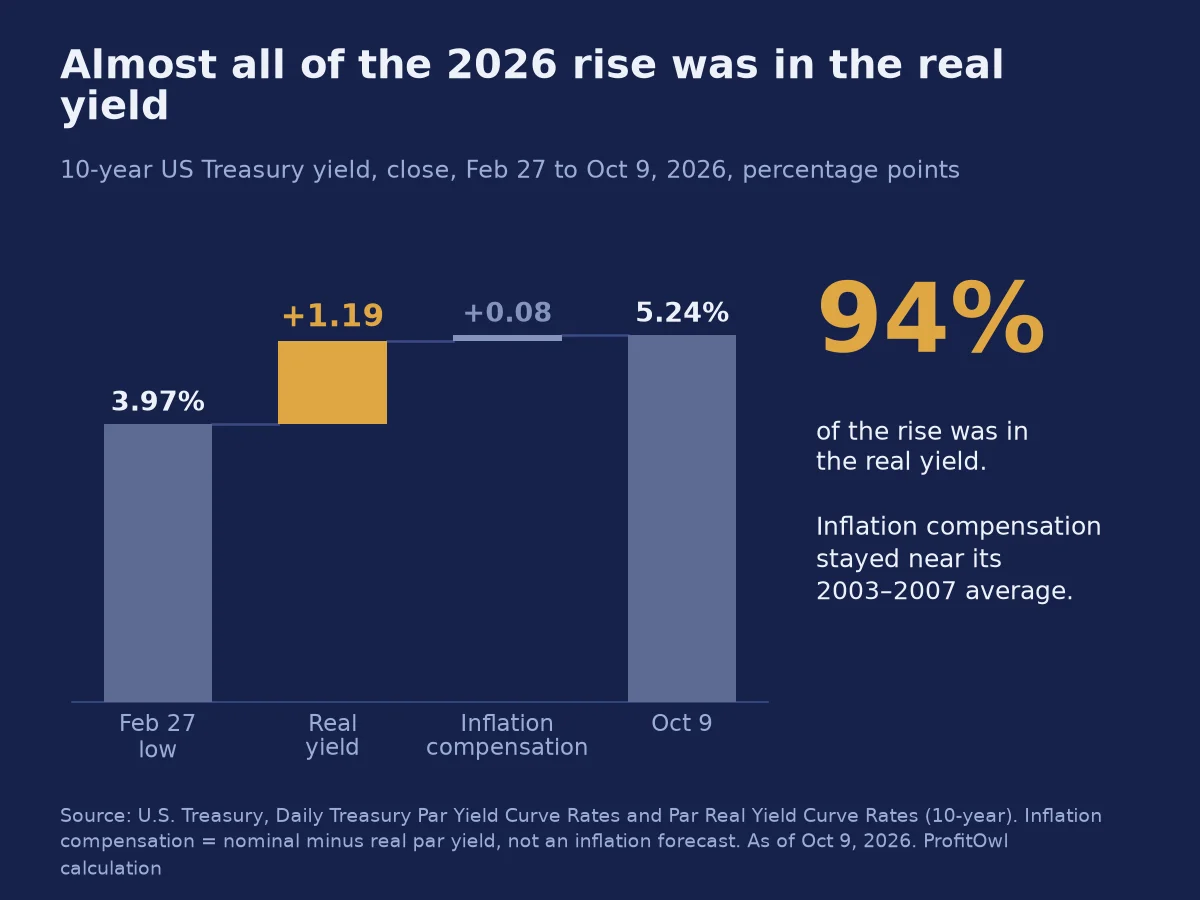
- US yields rose in 2026 mainly through real rates and a move shared with other large bond markets, led at the short end by the Fed. Debt explains little of the jump.
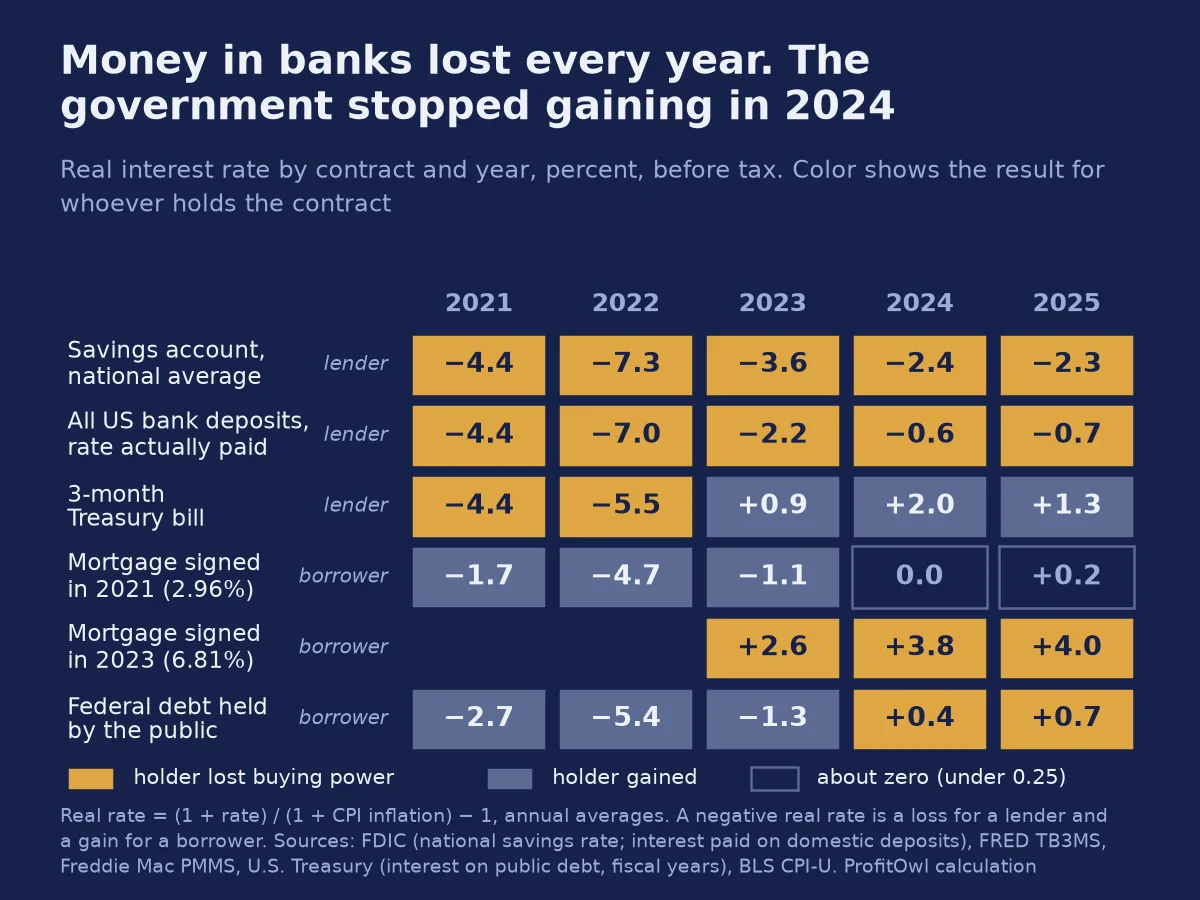
- The inflation of 2022 moved money from lenders to borrowers along existing contracts. Money in US bank accounts lost buying power every year from 2021 to 2025. The federal government gained in 2022 and 2023 and stopped in 2024.
The claims we have tested
| Claim | Verdict | As of | Note |
|---|---|---|---|
| “Yields rose because inflation is back” (US, 2026) | Doesn’t hold | October 9, 2026 | Why US Bond Yields Rose in 2026 |
| “The Fed did it” (US, 2026) | Half true | October 9, 2026 | Why US Bond Yields Rose in 2026 |
| “Rates are high because Washington borrows too much” (US, 2026 rise) | Doesn’t hold | October 9, 2026 | Why US Bond Yields Rose in 2026 |
| “Rates are high because Washington borrows too much” (US, level against earlier decades) | Can’t be settled | October 9, 2026 | Why US Bond Yields Rose in 2026 |
| “Investors demand a bigger premium” (US, 2026) | Half true | October 9, 2026 | Why US Bond Yields Rose in 2026 |
| “It’s global” (US, 2026) | Holds | October 9, 2026 | Why US Bond Yields Rose in 2026 |
| “AI is soaking up capital and pushing up rates” (US, 2026) | Can’t be settled | October 9, 2026 | Why US Bond Yields Rose in 2026 |
| “Inflation is a tax on savers” (US bank accounts, 2021–2025) | Holds | October 12, 2026 | Who Paid for Inflation? |
| “Governments inflated their debt away” (US, 2022–2025) | Half true | October 12, 2026 | Who Paid for Inflation? |
| “Borrowers won” (US, 2021–2025) | Half true | October 12, 2026 | Who Paid for Inflation? |
| “Banks pocketed the rate hikes” (US, 2015–2025) | Half true | October 12, 2026 | Who Paid for Inflation? |
| “The central bank made money on it” (the Fed, 2023–2025) | Doesn’t hold | October 12, 2026 | Who Paid for Inflation? |
| “Washington will just inflate its way out again” (US) | Can’t be settled | October 12, 2026 | Who Paid for Inflation? |
We add claims when the data can decide them, not on a schedule.
How we test
- Four verdicts. Holds. Doesn’t hold. Half true: right in part, or right for one window only. Can’t be settled: the data or the models don’t allow a verdict yet. Half true is the most common.
- The claim at its best. We state each claim in the strongest form we can find before we test it, and we name the strongest objection to our own verdict.
- Two models where nothing can be measured. The term premium or the natural rate of interest can’t be observed, only estimated. We always show two models, measured on the same day. When they disagree, the disagreement is the result.
- Every number checked. Each number in a note is tied to a line in our source register, with series, window, date and scope. A script checks it against the underlying table before publication.
- Dated, then updated. Every verdict carries the date of its data. When new data change a verdict, we update the note and log the change below.
What this is not
- Not a paper and not peer-reviewed. These are research notes by one practitioner.
- Not investment advice. “What would change the verdict” names a measurement, not a trading signal. Nothing here recommends buying or selling any bond or security named.
- Not a data service. We use public data from central banks, statistical agencies and regulators and link to the sources. We don’t republish their data. The source register and the scripts are not published with this project.
Who writes this
Philipp Misura spent nearly two decades in the financial industry and now advises banks on strategy.
Versions
- 1.0 (October 2026): project launched with the first note, Why US Bond Yields Rose in 2026: Six Explanations Tested, data as of October 9, 2026.
- 1.1 (October 2026): second note added, Who Paid for Inflation? Savers, Borrowers, Banks and Government, data as of October 12, 2026.
How to cite this
Misura, Philipp (2026). "Rates, Debt and Inflation: Testing What Everyone Says." ProfitOwl Research, version 1.1, October 2026. https://profit-owl.com/research/rates-debt-inflation-claims
Text and charts: CC BY 4.0 (opens in new tab). The underlying data belong to their publishers and remain under their terms; this licence does not cover them.
Primary sources
- 01Daily Treasury Par Yield Curve Rates and Par Real Yield Curve Rates — U.S. Department of the Treasury
- 02Treasury term premia (ACM) — Federal Reserve Bank of New York
- 03Yield curve models and data (Kim-Wright, Gürkaynak-Sack-Wright) — Board of Governors of the Federal Reserve System
- 04Budget and economic data (10-year budget projections) — Congressional Budget Office
- 05EDGAR XBRL company facts — U.S. Securities and Exchange Commission
- 06Measuring the natural rate of interest (Holston-Laubach-Williams) — Federal Reserve Bank of New York
- 07Natural rate of interest (Lubik-Matthes) — Federal Reserve Bank of Richmond
- 08National rates and rate caps (savings, monthly) — Federal Deposit Insurance Corporation
- 09Primary Mortgage Market Survey (30-year fixed) — Freddie Mac
- 10Interest Expense on the Public Debt Outstanding — U.S. Department of the Treasury, Bureau of the Fiscal Service
- 11Federal Reserve Banks Combined Financial Statements 2025 and 2024 — Board of Governors of the Federal Reserve System
Written by Philipp Misura, who is not a researcher by profession — see about. Corrections go on this page, marked and dated, rather than being made quietly.