Should You Pay Off Debt or Invest First?
Paying a debt down is a guaranteed return: its interest rate. Compare that with what investing might earn — and note the answer has just flipped in the US.
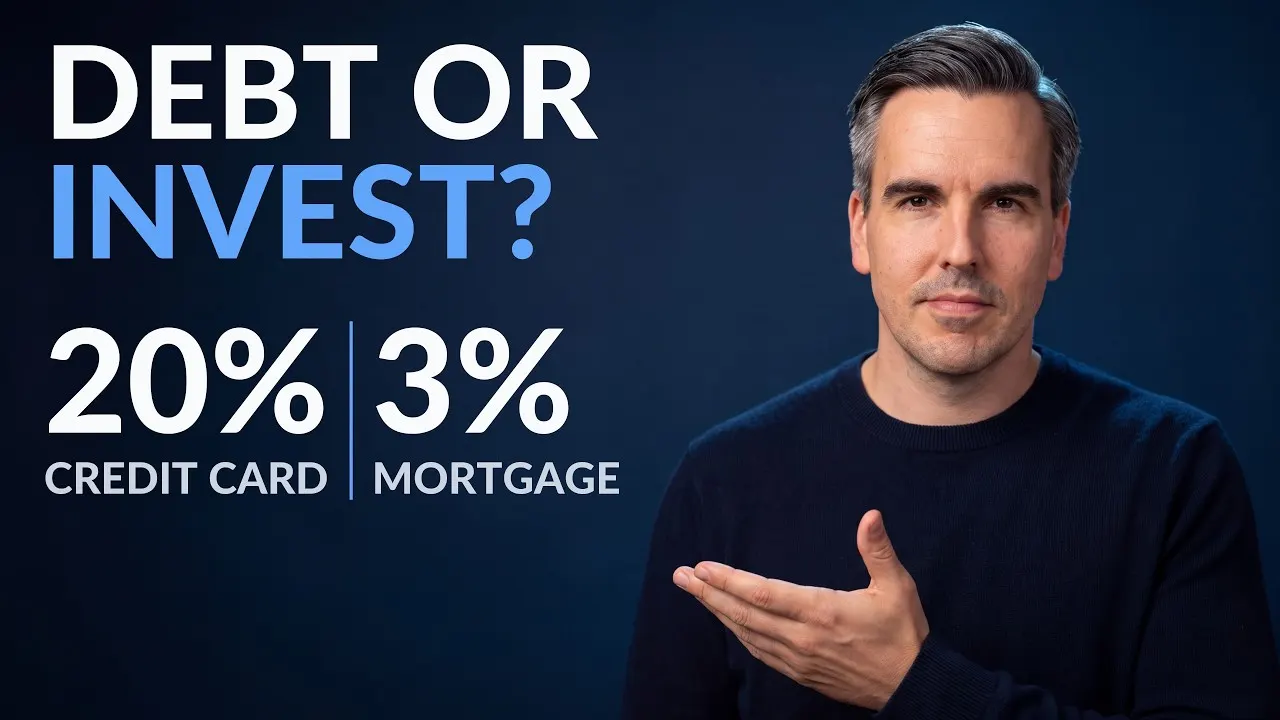
Pay Off Debt or Invest? Why Companies With Billions Still Borrow
Prefer to watch? This article is the written companion to the video above.
Some of the most profitable companies in the world sit on billions in cash. And they still borrow money.
That sounds backwards. If you have the cash to pay for something, why take on debt to do it instead?
Because they are not asking your question. Whether debt is good or bad does not come into it at all. They are asking something colder — and a great deal more useful.
Debt has a price. That is the whole idea.
In banking we do not start with how debt feels. We start with what it costs.
When a company borrows, it knows the interest rate exactly. Then it asks one question: can this money earn more than that? If the debt costs 4% and the cash can earn 8%, the company keeps the debt, puts its money to work and pockets the difference. That gap has a name — the spread — and optimising it is ordinary corporate finance rather than recklessness.
Now point that at your own life. This is the part most people never hear.
Paying off a debt is not just getting rid of it. It is earning a return, and a guaranteed one.
The reframe
Paying the debt down
A guaranteed return
Clear a loan charging 6% and you have earned a risk-free 6%. No market has to cooperate — it is fixed by the terms of your loan.
Investing instead
An expected return
World equities returned 5.2% a year in real terms across 125 years — an average containing decades you would not have enjoyed living through.
So the question is never "is debt bad". It is: can my money earn more than this debt costs? That gap is the spread — and right now it depends enormously on where you borrowed.
30-year fixed, Freddie Mac, 30 Jul 2026
Fixation over 10 years, ECB, Jun 2026
That chart is the reason this article could not have been written the same way two years ago. The classic advice, keep the cheap mortgage and invest the difference, was built in a world of 2% and 3% mortgages. In the euro area that world still exists. In the United States, at 6.66%, the reward for taking market risk instead of paying down has shrunk to well under a percentage point.
Not wrong. Just far thinner than the advice assumes, and the advice has not caught up.
One number decides almost everything
One number decides it: the rate
No mainstream investment reliably earns 20% a year. None. Paying this off is a guaranteed return nothing on the market will hand you — this is not really a decision.
Credit cards (over 22% on average), consumer loans, overdrafts
A long-term investment might just beat it, or might not. When it is this tight the maths will not hand you a clean answer — which is exactly where the human check below takes over.
Car loans, student loans, newer mortgages in higher-rate markets
Over long periods a broad, diversified investment can reasonably be expected to out-earn the debt. Holding it while you invest is what a company would do — and here the logic transfers.
Mortgages fixed when rates were low, subsidised loans
One honest note that cuts both ways: tax can move the line. Sometimes the interest you pay is deductible; sometimes your investment gains are taxed heavily. Either way it changes the spread — so check the rules where you live before treating any of this as settled.
The two extremes are easy, and nobody really argues about them. Expensive consumer debt is a fire and you put it out. A subsidised loan at almost nothing can sit where it is for years without doing you any harm.
It is the middle that people actually live in, so let us make the middle real.
Say you have €10,000 spare and a mortgage at 3%. Pay it down and you save €300 a year. That €300 is not a forecast. It arrives whether the market rises, falls or does nothing at all. It arrives in the year of a crash exactly as reliably as in a good year, it needs no decision from you once it is done, and it keeps arriving for as long as the debt would otherwise have run.
Invest the same €10,000 instead and over the long run you might make €600 or €700.
Might. Some years you will be down, and you will feel it, and that feeling tends to arrive at exactly the moment the guaranteed €300 would have looked most attractive.
So the real trade is not “debt versus investing” in the abstract. It is a certain smaller number against an uncertain larger one, and the honest way to settle it is to ask what you are being paid for carrying the uncertainty. At 3%, against what a long-run investment could reasonably return, you are being paid a decent amount. At 6.66%, as the chart above shows, you are being paid almost nothing, and you are still carrying the whole of the risk.
Which quietly changes the question. You stop asking whether debt is bad, and start asking what you are being paid to keep it. That is the same question a credit desk asks about every position it holds, and as far as I can tell it is the only version of the question that survives contact with a real interest rate.
One limit is worth naming rather than glossing over. The debt side of this comparison is printed on a contract; you can read it off a statement to two decimal places. The other side is an estimate wearing a decimal point. Everything in this section is only as good as the return you assume, which is why the answer gets more solid the higher your debt rate is, and mushier the lower it goes.
And then the part the spreadsheet cannot see
Work out the spread, keep cheap debt, invest the difference, and you are doing exactly what a corporation does.
But you are not a corporation, and copying one blindly is a mistake.
Where the corporate logic stops
A company
Optimises the spread
- When cash runs short
- Borrows more — it has standing credit lines.
- If one bet goes wrong
- Writes it off, moves on. It is diversified by design.
- At three in the morning
- Feels nothing. A balance sheet does not lie awake.
- What it optimises for
- Return on capital. The last percentage point.
You
Optimises for a good life
- When cash runs short
- Asks a bank at the worst possible moment. Often gets no.
- If one bet goes wrong
- One job, one household. You cannot write off your life.
- At three in the morning
- Checks the market on your phone. That has a cost no model shows.
- What it optimises for
- Job security, your family, your own nervous system.
The spread tells you what is optimal. It does not tell you what lets you sleep.
The difference that matters most is the least obvious one: credit access. A company that runs short of cash borrows more. It has standing facilities and a market that will lend to it. When you hit a real emergency, that is the worst possible moment to go asking a bank for money, and often you simply cannot.
A corporation’s debt is safe partly because it can always refinance. Yours is not.
Which is exactly why the buffer from the last episode comes first. It is the access to cash a company takes for granted, and the one you have to build for yourself before any of this arithmetic applies.
On the close calls, choosing peace over a single percentage point is not weakness. A bank chases the last percent because it feels nothing at three in the morning. You are allowed to optimise for a good life instead.
How to actually decide
- Write down the interest rate on every debt you have. All of them, on one page. Most people have never seen this list in one place, and it is usually the most clarifying ten minutes of the whole exercise.
- Buffer first. Fixed costs times your fragility, and the method is here. Without it, one bad month undoes everything below.
- Clear anything above roughly 10%, starting with the highest. No debate, no spreadsheet.
- On the rest, compare the rate with what a long-term investment could reasonably earn. Mind the gap, and be honest that it is thinner than it used to be.
- Run the human check. On anything close, ask whether you will actually sleep. If the debt weighs on you, clear it.
The money you free up to invest is the engine, layer three, compounding quietly in the background. What it becomes over decades is the reason any of this is worth the trouble.
So where does that leave you
Debt is not a moral failure. It is a price. Professionals know exactly what theirs costs and whether it is worth paying, and there is no reason you cannot know the same about yours.
Once the debt and the investing are working together, a much bigger decision is usually waiting: the largest purchase most people ever make. Should you rent, or should you buy? That is next, and there is a calculator for it already.
Educational content only — not investment, tax or legal advice, and not a personal recommendation. Rates cited are averages at the dates given and change constantly; check your own. Speak to a qualified, licensed professional before acting.
Keep going
Finished reading? Three places to go next
- Try it with your numbersCompound growth on your own numbers See the year your growth overtakes what you paid in, and where the balance ends.
- Next in Money Decisions · episode 3Should You Rent or Buy a Home? The Half Nobody Checks The money question is only half of it. A bank checks four things before it checks the return — leverage, liquidity, concentration, time. Run both halves here.
- On YouTubeSubscribe on YouTube (opens YouTube in a new tab)New videos every Tuesday: one money question per episode, checked against the data.
Primary sources (4)
- 01Consumer Credit — G.19: average APR on credit-card accounts assessed interest, 22.15% (Q2 2026) — U.S. Federal Reserve
- 02Primary Mortgage Market Survey — 30-year fixed-rate mortgage averaged 6.66% (week of 30 July 2026) — Freddie Mac
- 03Euro area bank interest rate statistics, June 2026 — housing loans with fixation over ten years at 3.34% — European Central Bank
- 04Global Investment Returns Yearbook 2025 — world equities 5.2% a year real, 1900–2024 — UBS / Dimson, Marsh & Staunton (London Business School, Cambridge)
Questions people actually ask
Is it better to pay off debt or invest?
Compare two numbers. Paying a debt down earns you a guaranteed, risk-free return equal to its interest rate — clear a loan charging 6% and you have effectively earned 6%, fixed by the terms of the loan. Investing earns an uncertain return: world equities delivered 5.2% a year in real terms over 125 years, which is an average, not a promise. If the debt costs more than the investment can reasonably be expected to earn, pay it down. If it costs clearly less, investing alongside it is defensible. The honest complication is that the gap between those two numbers has narrowed a lot.
What debts should I pay off first?
Anything above roughly 10%, and it is not really a decision. Credit cards averaged over 22% on accounts assessed interest in 2026 according to Federal Reserve data, and consumer loans are often not far behind. No mainstream investment reliably earns 20% a year, so paying that off is a guaranteed return the market will never hand you. Work down from the highest rate. Only once the expensive debt is gone does the comparison with investing become interesting at all.
Should I pay off my mortgage early or invest?
It now depends heavily on the rate you actually hold. A US 30-year fixed mortgage averaged 6.66% at the end of July 2026 (Freddie Mac); against a long-run equity expectation of roughly 7.3% in nominal terms, that leaves a spread of well under one percentage point — very little reward for taking market risk. In the euro area, where rates fixed for over ten years averaged 3.34% in June 2026 (ECB), the spread is closer to four points and investing alongside the mortgage is much easier to justify. Someone who locked in at 3% before rates rose is in the second situation regardless of where they live: what matters is your rate, not your country.
Why do profitable companies borrow money instead of using their cash?
Because they are not asking whether debt is good or bad — they are asking what it costs against what the money can earn. If debt costs 4% and the cash can be put to work at 8%, the company keeps the debt, invests the cash and pockets the difference. That gap is called the spread, and optimising it is ordinary corporate finance rather than recklessness. The same arithmetic applies to your own money, right up to the point where the differences between you and a company start to matter.
Why can't I just copy what companies do with debt?
Because of one difference that outweighs the rest: access to credit. A company can usually borrow more when cash runs short — it has standing facilities and a relationship with the market. When you hit a genuine emergency, that is the worst possible moment to ask a bank for money, and often you simply cannot. A corporation's debt is safe partly because it can always refinance; yours is not. That is precisely why an emergency buffer comes before any of this maths.
Should I invest while I still have debt?
Often yes, if the debt is cheap and your buffer is in place — but the order matters. First, a cash buffer sized on your fixed costs, so a setback does not push you further into debt. Second, clear anything at a high rate. Third, on what remains, compare the rate with what you could reasonably expect to earn. Many people end up doing both at once: paying a low-rate mortgage on schedule while investing the surplus. That is not a compromise, it is usually the right answer.
Does it ever make sense to pay off cheap debt anyway?
Yes, and it is not irrational. If carrying that mortgage while you invest leaves you tense and checking the market every week, the maths is winning an argument that is quietly costing you something it cannot measure. Choosing certainty over a percentage point is the correct adjustment for being a human being rather than a balance sheet. A bank chases the last percent because it feels nothing. You are allowed to optimise for sleeping through the night.
How does tax change the debt versus invest decision?
It can move the line in both directions, which is why no general rule survives contact with a real tax code. In some countries mortgage interest is deductible, which lowers the effective cost of the debt and favours investing. In others investment gains are taxed heavily, which lowers the effective return and favours paying down. Both effects change the spread rather than the logic. This is a description of the mechanism, not tax advice — worth having checked for your own situation.